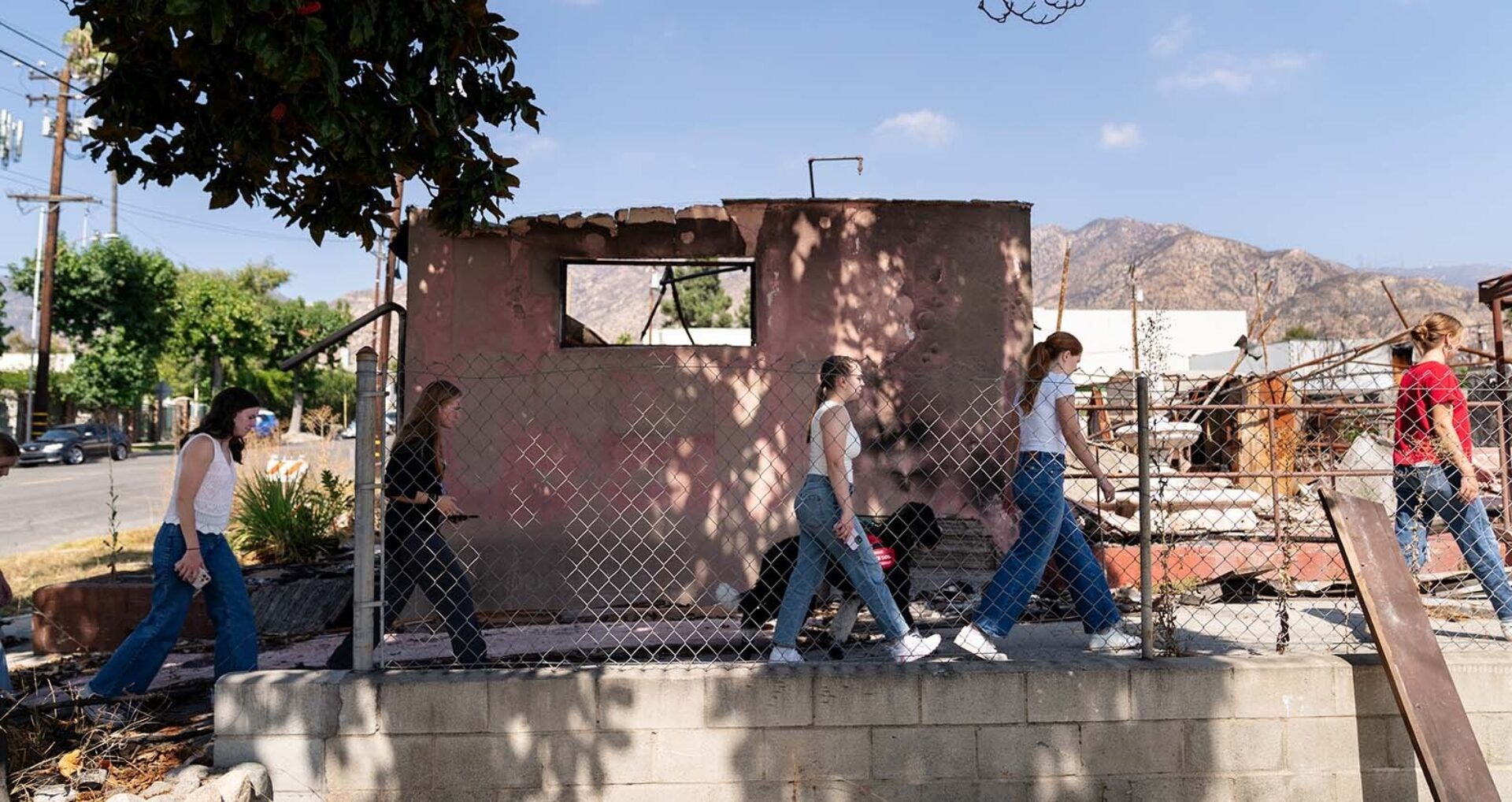
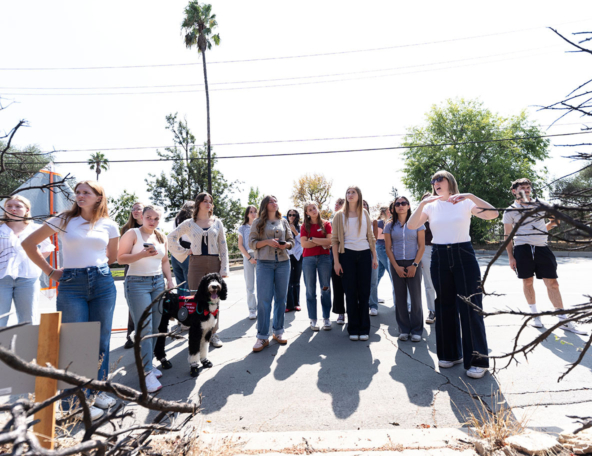
(Above image: Students explore the aftermath of Altadena fires to immersive themselves in the reality of what they are restoring. Image courtesy of Casey Martin)
In January 2025, wildfires swept across California, hitting Altadena and neighboring communities in Los Angeles County. This tragedy affected thousands of people’s homes, businesses, and communities, leaving them to face uncertainty about how and when rebuilding would take place. In response, IIDA’s 2026 Campus Center Award winner, George Fox University, came together to support these families in their time of need.
Assistant professor of interior design at George Fox University, Casey Martin, IIDA, brought together students to confront what it means to design in the aftermath of devastating loss through their Altadena Rebuild Project. To gain insights, Martin took the students on a day trip to Altadena to see the destruction the fire left behind. During their trip, students saw the impact of the fires firsthand and listened to the stories of families trying to rebuild their lives. After seeing what communities lost, students banded together to discuss next steps to help restore this once-vibrant community.
Close collaboration with residents gave students the opportunity to learn how to balance practical design solutions with empathy. Navigating the long process of rebuilding alongside affected families, George Fox students forged a commitment with the community. “The rebuilding process is long and ongoing in Altadena, so we’ll be here as long as the community needs us. Logistically, that means more students come onto projects as other students graduate, as we move forward," said Martin.
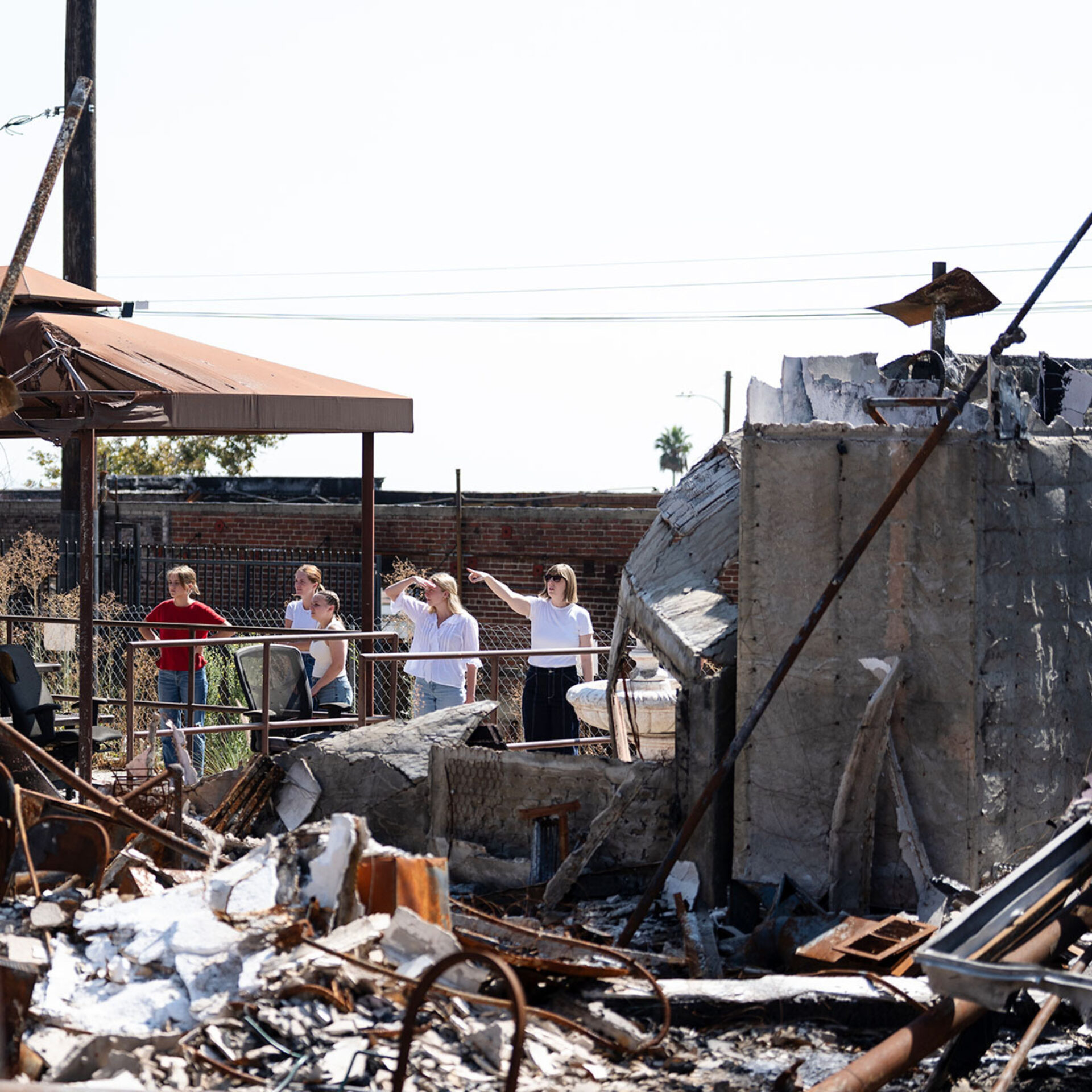
Image courtesy of Casey Martin
Their work also challenged traditional ideas of what an interior designer does. Students discovered that thoughtful design can do more than rebuild spaces; it can foster healing and help a community move forward.
We talked with Martin and interior design students Ava Mueller and Mya Hong about the experience of designing alongside a community and the impact this project had on them.
Responses have been lightly edited for length and clarity.

Casey Martin, IIDA
Assistant Professor of Interior Design
George Fox

Mya Hong
Interior Design Student
George Fox University

Ava Muller
Interior Design Student
George Fox University
Your students look to you for guidance. What, if anything, did you learn from them during this experience?
Casey Martin (CM): I was really taken aback by how seriously the students took these projects. We worked on both residential and commercial spaces in Altadena, and they approached each project with the dignity and respect it deserved. The students really felt like they could help this community, and we took that seriously from the start, something I think they will carry with them as designers in the future.
When you first visited Altadena after the fire, how did that experience shape the way you think about design?
Mya Hong (MH): Living in California, I was very aware of the effect the fires were having on countless people’s lives. It wasn’t until I visited one of the project sites that I realized how much destruction the fires truly caused. I can still remember driving through the neighborhoods and seeing empty plots of land or the subtle remains of what used to be someone’s home. This was heartbreaking to see firsthand and deeply shaped how I viewed our work as designers. Design became so much more than creating beautiful and sustainable spaces; it became a way to help other people rebuild their lives. It put my role as a designer into a much greater perspective. I felt a new sense of responsibility to my community and clients, knowing that my abilities could change lives for the better.
Ava Mueller (AM): Our trip to Altadena completely shifted the way I think about design. Seeing the destruction of once-thriving historical buildings and homes firsthand, all at once, broke my heart and made me realize the incredibly unique responsibility we carry as designers. If we design buildings and homes thoughtfully for beauty and functionality, we can design for disaster prevention, too. With each selection and decision we make in design, we have the opportunity to both help people connect with a space and to protect them within it.
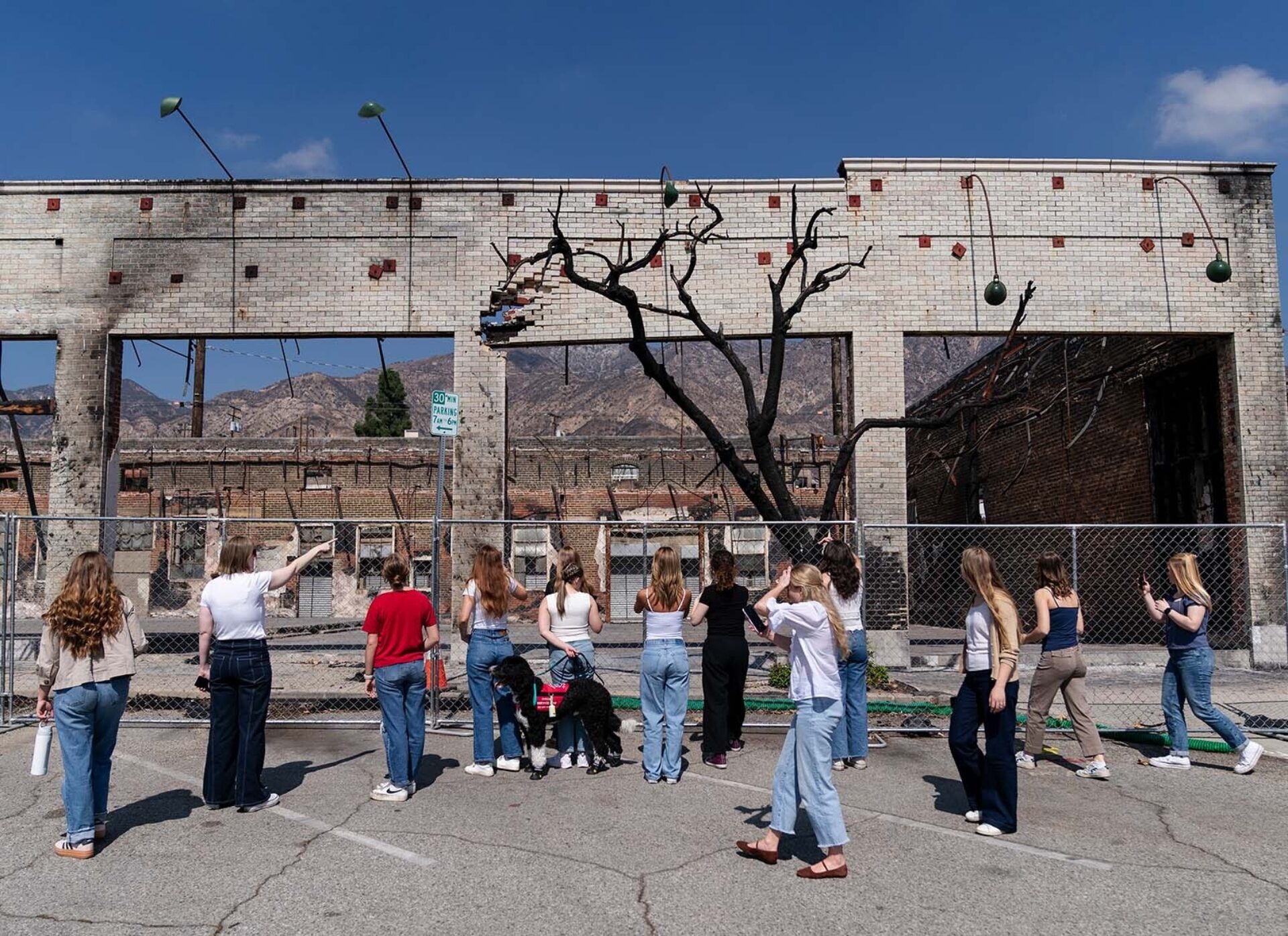
Students visit the sites of the fire to see what they are tasked with helping rebuild.
Image courtesy of Casey Martin
What were some unexpected challenges you faced and how did you overcome them?
CM: I think our biggest challenge, honestly, has been the wide breadth of requests we’ve received for help. Some families need help sourcing new furniture because they had to throw all their remaining items away. Some families needed help with floor plans. Some just needed help picking out kitchen knobs. We had to flex and pivot with each project because the needs were so widely different.
What was the most rewarding design challenge you worked on during this project, and what did you learn from it?
MH: I had the privilege of working on the very first house for this project. The house wasn’t entirely burned down, but it had taken a lot of internal damage from the fires. We had to go in and redo a significant amount of the foundational elements while preserving the integrity of the home. Because the house was originally built in the 1920s, it was challenging to find similar finishes and furniture pieces that matched the beautiful style of the original design. This project helped me appreciate designs from different time periods while also helping me see how this field continues to evolve.
AM: The most rewarding part of this project was working on a redesign of the Woodbury Building, a beloved 100-year-old business complex that had burned down in the fire. Learning the building's history and then seeing its leftover skeleton in person hit me harder than I thought it would. All that history, seemingly gone in an instant.
Walking around the burned building, I realized that not all was lost in the flames, though. Strength was found in the ash-covered walls left behind. Resilience was found in the melted glass dripping from the twisted window panes. And hope was found in the fire-faded words printed on the concrete outside the building that read “I HOPE U KNOW HOW LOVED U ARE.” In our redesign of the Woodbury Building, my partner and I made it our priority to both preserve the history of the building and to build it back stronger for the future. We selected exclusively fire-resistant materials, and we included a quiet space in the center of the building dedicated to remembrance of the fire, healing, and stepping into the future.
Working on the building taught me that pictures can only tell part of the story. To design a space well, I think it’s so important to see it in person, to understand the unique feeling each space has, and to capture that feeling in the new design. That way, the new space isn’t completely new; the history and the new elements can blend to create spaces that aren’t just rooms– they’re rooms full of life and memory.
Working directly with real clients is very different from a typical classroom project. What surprised you most about collaborating with the community during this experience?
MH: One of the most rewarding aspects of this project was getting to know the clients and seeing how the community came together amid the devastation. I was able to talk with my client one-on-one about her family’s personal experience with the fire. Hearing how much was destroyed made the project so much more personal. I felt like I was able to contribute in a small way to regain what was lost. It was also encouraging to hear stories about neighbors and community members coming together to support one another in the midst of a difficult time. It was surprising to hear how even though these people had lost their homes and possessions, they still contributed what they had to help each other.
AM: I think what surprised me the most about collaborating with the community during this experience was the strength and love people had even in the face of such hardship. Listening to people’s stories of how they lost their homes and neighborhoods to the fire, it was so clear that despite their heartbreak, the hope they had overpowered the pain. The fire didn’t destroy the Altadena community; it drew them together. For that reason alone, it was clear that Altadena would be built back stronger than before.
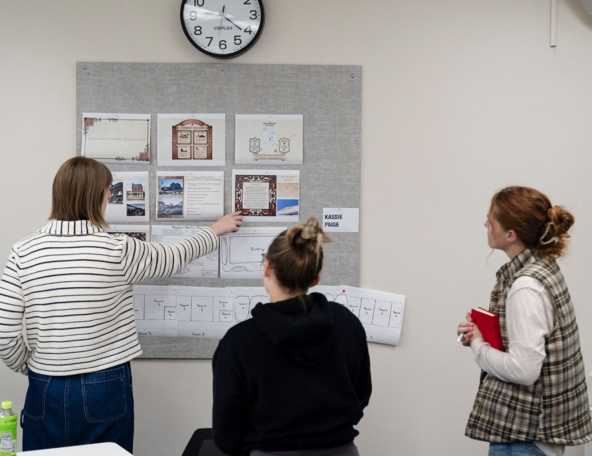
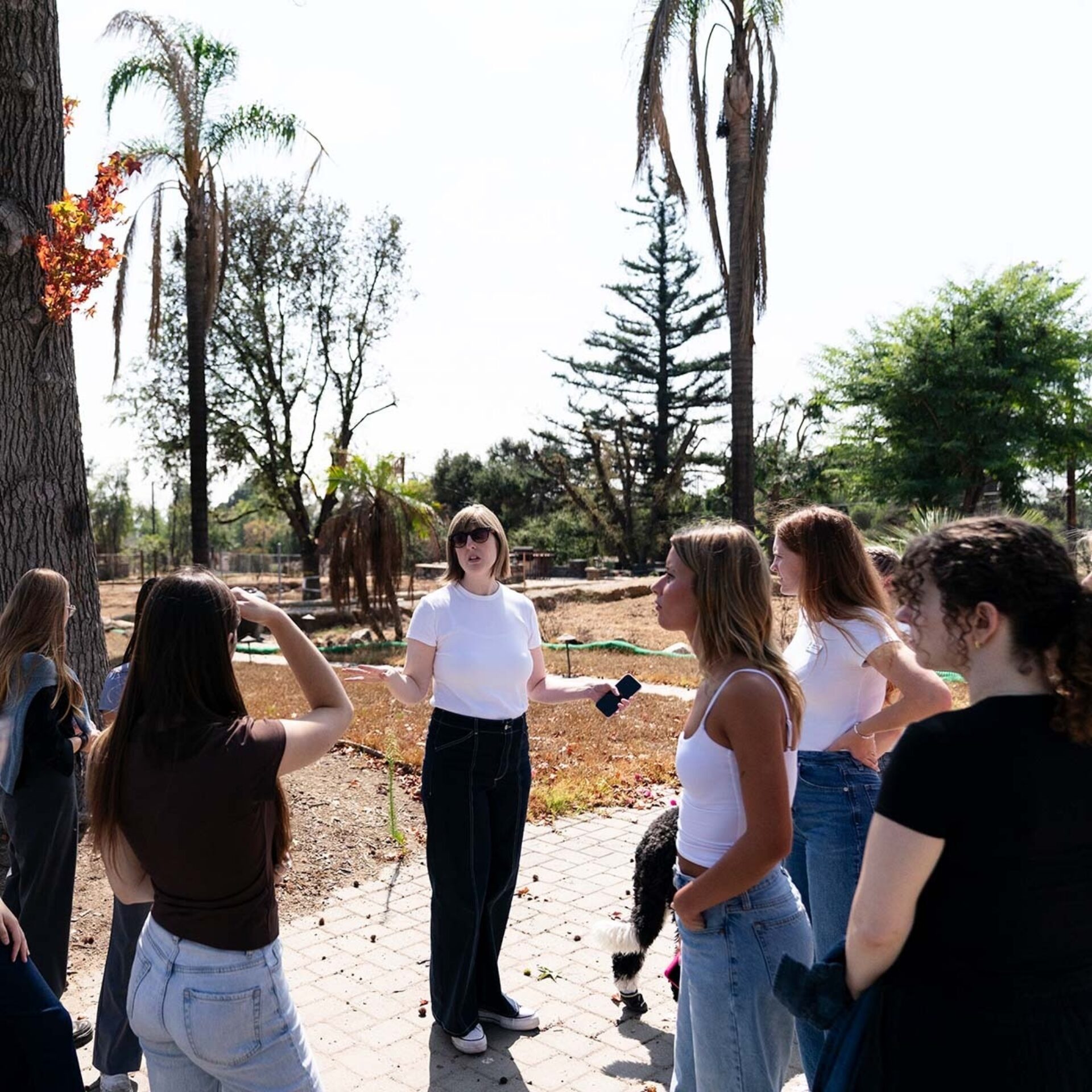
Martin and students look at different ways they can support these families in need throughout the design process, making sure the rebuilding process goes as smoothly as it can for them.
Image courtesy of Casey Martin
Seeing the loss of vitality in the community made students realize how important design can be to restoring communities and providing hope for the future.
Image courtesy of Casey Martin
How has working on the Altadena Rebuild Project influenced your understanding of the role interior designers can play in helping communities recover after a disaster?
AM: Working on this project has shown me that interior design is about so much more than creating beautiful and functional spaces. It’s about serving the communities around us in need, and designing to bring people together. It’s about intentional, thoughtful, and responsible material choices. And after disasters, our role as interior designers is not to cover up what happened; it’s to bring healing through designs that honor the tragedy while looking forward to a safer, brighter future.
MH: Being able to work on this project has helped further my understanding of my role within my community. As an interior designer and community member, I feel a responsibility to create spaces that are both functional and beneficial to the well-being of others. My goal is to use my skills and abilities to serve those around me.
Looking back on this experience, what would you want others to understand about the impact design and empathy have in helping communities heal?
CM: I think for me, this experience alongside my students was so powerful because we all realized the gravity of what we were doing, but we also just jumped in and started. We saw a community that needed help and we just acted. Design has the capacity to do incredible things in our communities but often we get held up in the tiny details. And while those are still very much important, there is also something to be said about action. The other thing that struck me on these projects is how thoughtful my students were in how they designed for these clients. Those thoughtful design decisions really touched the clients and allowed the students to really draw from the cultural heart of Pasadena and create real meaning for the community. Design has such a profound impact on the people who use these spaces and to tie design to such a lively local culture — that’s the real reason why design is so powerful.
One of the families the students helped, the Berrys, shared what the students’ service meant to them:
“It meant more than anyone can imagine. Losing everything in the Eaton Fire and then having to rebuild is daunting. Knowing that the George Fox students wanted to be of service to us was so kind and comforting, way beyond the build itself,” said Susie Berry.
Image courtesy of Casey Martin
Looking back, how has participating in this project changed the kind of designer you hope to become?
MH: Looking back on this project has reshaped the kind of designer I want to be. My hope going forward is to be a designer who is marked by determination and empathy. I desire to design spaces that will bring the community together while also leaving a lasting mark.
AM: Looking back, working on this project has grown my ambitions and motivations as an interior designer, from wanting to design visually compelling spaces to wanting to design spaces that come full circle to honor history, help protect brighter futures, and, ultimately, bring people together.
Related Articles
-
Inside IIDA's National Student Design Charette
Five design students on collaboration, creativity, and teamwork -

The Design Career Starter Kit
Check out this three-episode webinar series built to empower students and provide them with the tools needed to move forward in their job search and early career -
Change Starts at the Chapter Level
We honor winners of the 2026 IIDA Chapter Awards for their dedication to improving the profession, one chapter at a time -
Felicia Bonillas: Passion Meets Purpose
The 2026 Anna Hernandez/Luna Textiles recipient reflects on her career and how she uses human-centered design to empower communities -

2026 IA Diversity in Design Scholarship Winners
These students use their voices and ideas to create a more inclusive design industry -

Leta Pham: Student Leader, Future Designer
IIDA’s 2026 Student of the Year, Leta Pham turned every opportunity into a step toward her design future