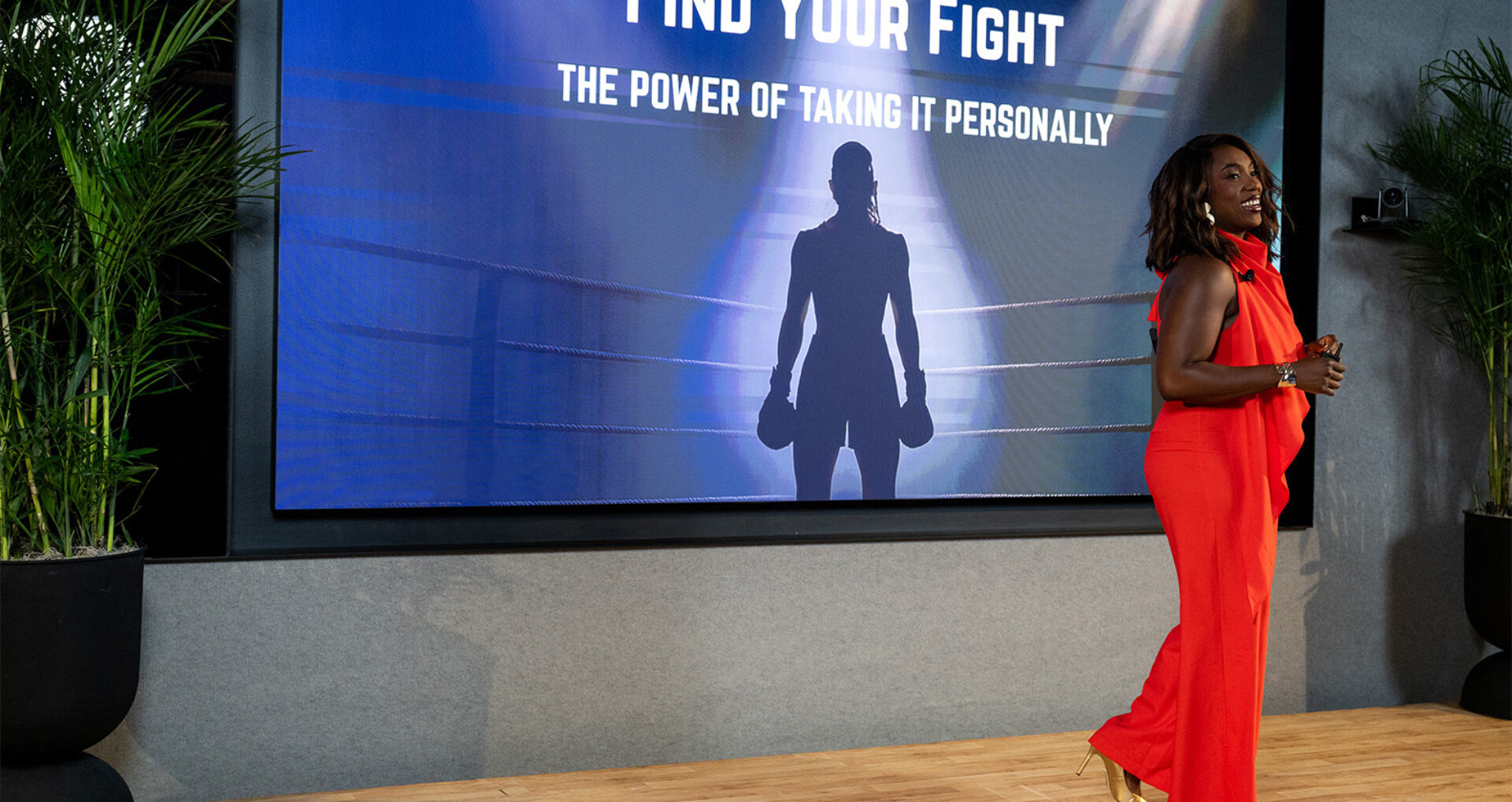
There’s a certain kind of advice most of us have heard at some point in our professional lives: Don’t take it personally. At this year’s NeoCon, inventor and entrepreneur Jessica O. Matthews made a compelling case for doing exactly the opposite.
In her keynote, “Find Your Fight: The Power of Taking It Personally,” presented by IIDA and introduced by IIDA Executive Vice President and CEO Cheryl S. Durst, Hon. FIIDA, Matthews reframed personal experience not as something to keep out of the room, but as one of the most powerful tools we have for creative problem-solving. “I believe that we’ve overcorrected in this idea of telling people not to take things personal,” she told the audience. “Because taking something personally is actually the way that you unlock your superpower around innovation.”
For Matthews, founder of Uncharted Power, a sustainable infrastructure company built around turning everyday motion into usable energy, that idea is anything but abstract. At 19, she invented the Soccket, an energy-generating soccer ball, inspired by her experience as a dual citizen of the United States and Nigeria — and by the stark realities of unreliable power.
It all started when she visited Nigeria as a teenager for a family wedding. When the power went out, as it often did, a diesel generator was brought in to keep the celebration going. As fumes began to seep into the room, she told her cousins, “I can’t breathe. I feel sick.” Their response stayed with her: “Don’t worry, you’ll get used to it.” Spoiler alert: She didn’t.
“Get used to what, exactly?” she remembered thinking. “We know that this thing is killing us. We know that this is horrible for the environment.” For Matthews, the moment crystallized a larger infrastructure crisis: When reliable power was not available, families were left to wait, turn to diesel generators, or rely on kerosene lamps — workarounds that came with real health and environmental consequences. Did you know that breathing kerosene fumes is roughly equivalent to smoking two packs of cigarettes a day, according to the World Bank?
After a year of painful and premature family deaths — losses she connected to unreliable infrastructure — what had been a larger problem became acutely personal. And because it was personal, it became impossible to ignore. That, Matthews explained, is where innovation often begins. “Innovation is the ability to see the world, not just as it is, but as it could be, and if you’re lucky, to play a role in it,” she said. But changing the world is also a fight. “If you think about the word disruption, it is inherently messy,” she added.
Matthews, who joked that her dream is to be “the perfect love child of Beyoncé and Bill Nye the Science Guy,” did not initially think of herself as a fighter. That changed, or at least began to, when she received the Muhammad Ali Humanitarian Award for Confidence at 26. “You’re a fighter,” the icon himself told her. It took years, Matthews said, to understand what he had seen in her before she could fully see it herself.
She offered the audience three ways to find their own fight: embrace your origin story, embrace your petty side, and embrace your lived experience. The “petty side,” she clarified, is not about being small or resentful. It is about noticing the things that bother you, wound you, or make you say, that shouldn’t be this way — and then doing something with that energy.
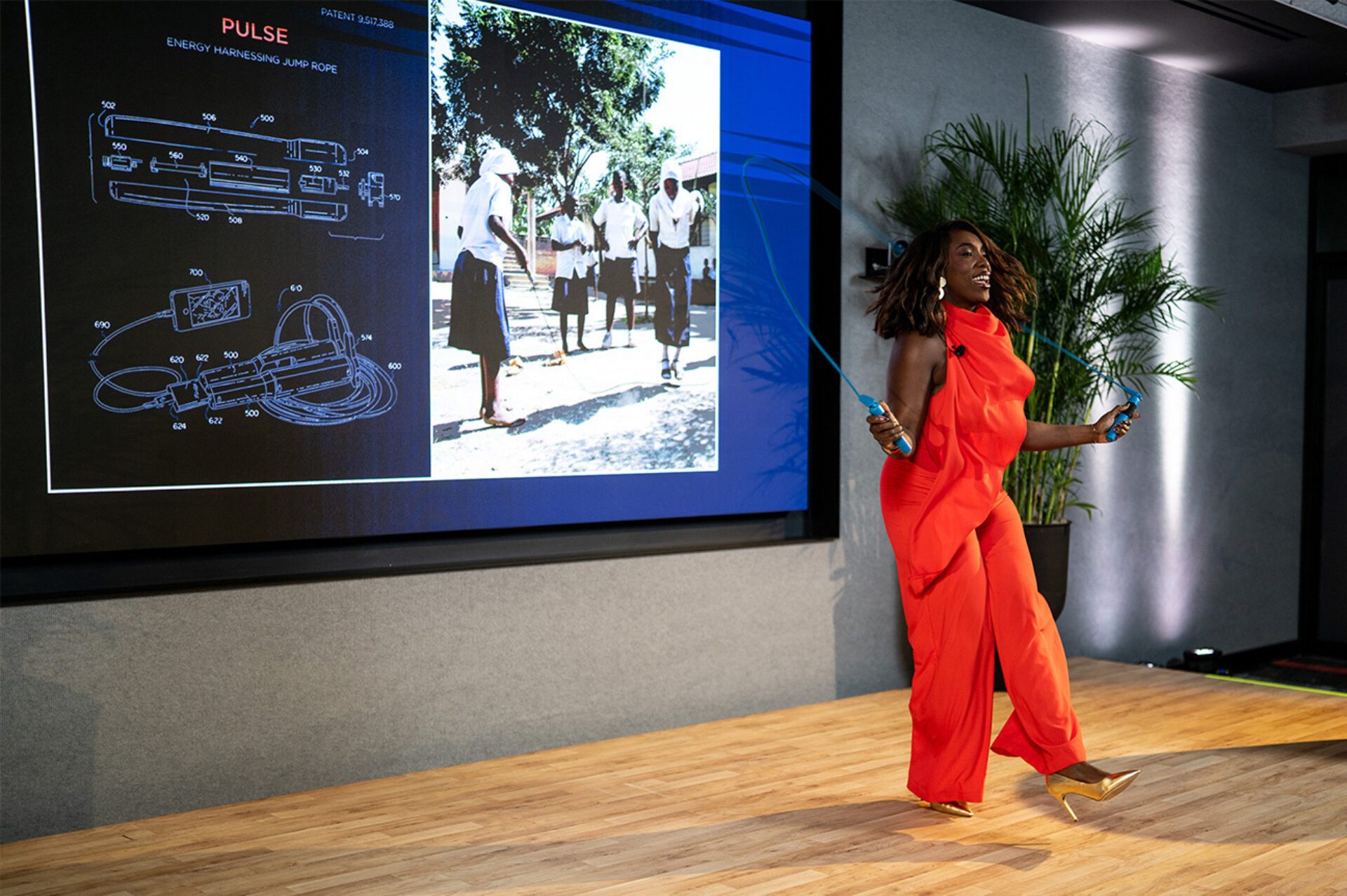
For Matthews, one such moment came years ago in a refugee camp on the border of Jordan and Syria, where she learned that girls were not allowed to play outside because camp administrators feared they were “too tempting to the boys.” As you can imagine, she took that personally. The result was Pulse, an energy-generating jump rope designed so girls could play indoors and still generate light. To demonstrate the technology onstage at NeoCon, Matthews picked up the rope herself — wearing a bright orange jumpsuit, and very high heels and all — and began jumping, at one point on one foot, without losing her breath or the thread of the story.
And the story gets better: While the energy-generating soccer ball was designed to produce three hours of light with just one hour of play, Matthews and her team made the jump rope even more efficient. “Fifteen minutes of jumping will give you an hour of light,” or “an hour Double Dutch will give you four hours of light,” she said. “Because I’m a little petty!”
“There are gonna be things that irk you,” she added. “Things that feel annoying, that feel like a hurt, the microaggressions. You take the core of it, and you say, you know what? How do I innovate around this?”
Just as importantly, she urged designers and leaders not to dismiss the ordinary. When her engineers were struggling to figure out how different energy-generating nodes could communicate without draining the network, Matthews looked at the diagram and saw something familiar. “My mom has already solved this,” she remembered saying. “This reminds me of how my mom keeps our family network together.”

In her family, everyone spoke to her mother at least once a day, sharing what was happening in their own lives while her mother shared updates about everyone else. “My mom kind of works as this mother node,” Matthews said, “going around, sharing information, and letting us know when we need to have a direct communication.”
That everyday observation became the basis for a patent — and not just any patent. Matthews said it remains the fastest patent her company ever received, later cited more than 45 times by companies including Toshiba, Sony, Intel, Qualcomm and Analog Devices. What began as a story about family phone calls became part of a much larger conversation about 5G, wireless communications, and mesh networks.
“Innovation is often just pattern magic,” said Matthews, who recently sold her company’s energy-generating technology and is now focused on helping others become innovators, in part through her new venture, Lived Labs. “Being able to see something in other parts of your life, see that it works, understand the system, and apply it to something that you think is totally different.”
Matthews found a fitting point of connection with an audience of designers when she recounted one of the first major purchases she made for her office: a Herman Miller Eames chair. It mattered not only as an object, but as a marker of arrival. For her, it was the moment she thought, “You know what? I’m a real boss. I’m doing something.” She still has the chair in her home office, she said, because it reminds her of exactly how she felt when she could afford to buy one. “I think it’s those types of things in our environment,” she said. “They remind us of where we’ve been, and where we’re going, and in that way, create the setting for innovation.”
By the end of the keynote, taking it personally no longer sounded like a liability. It sounded like a method: a way of paying attention, of refusing resignation, of turning memory, frustration, culture, care, and even pettiness into the raw material for something new.
Matthews left the audience recharged — pun intended — and with a new way of seeing themselves. “You are already an inventor,” Matthews concluded. “You’re already an innovator. You’re already a scientist, and the more that you live, and the more that you can pull from that life, the ability to innovate becomes endless.”
Related Articles
-
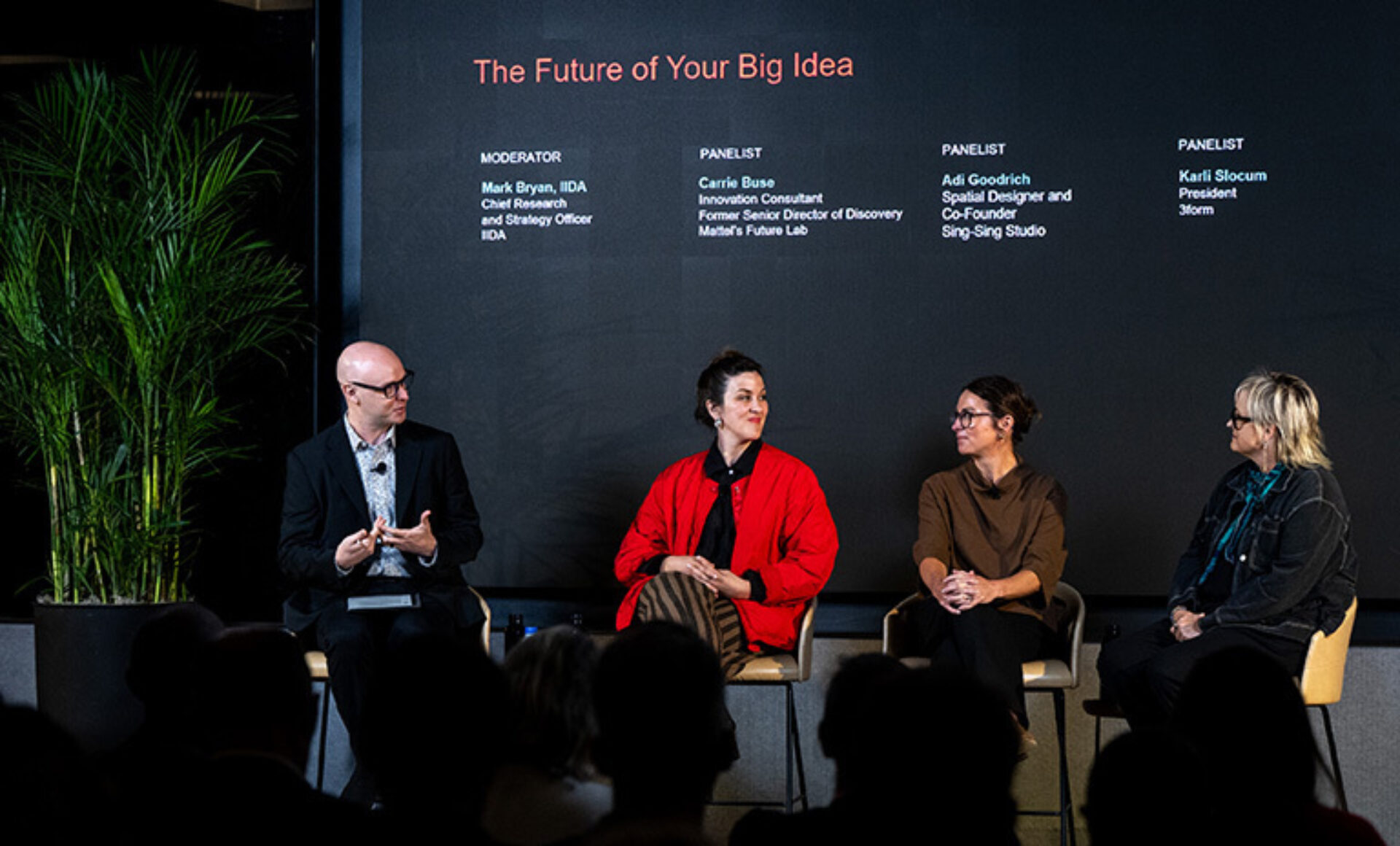
The Future of Your Big Idea
Inside IIDA’s Collective Design LIVE during Chicago Design Week -

Best of IIDA at Chicago Design Week
From fresh insights to award celebrations and fun giveaways, here are the moments you might’ve missed -

What Inclusive Design Really Looks Like
IIDA Collective Design Live at NeoCon brought leading voices together to explore what inclusion really means in the built environment -

Annie Jean-Baptiste on Why Design Starts at the Margins
The Google executive and author spoke at NeoCon on inclusive design: “When you build for the margins, you get the center for free” -

The Best of IIDA at Chicago Design Week
From illuminating conversations to award celebrations and furry friends, here are the key moments you might’ve missed -

Announcing Chicago Design Week
A proclamation from local lawmakers recognizes Chicago as a design epicenter and formally establishes a citywide design week