
- by Mark Bryan
- Product Design, Industry Insights, Business of Design, Future of Design
The Future of A&D Sales
-
- by Mark Bryan
- Published in Product Design, Industry Insights, Business of Design, Future of Design
For most of my career, a good A&D rep has been part salesperson, part product expert, part researcher, part project tracker, and sometimes part therapist when the thing everyone loved is suddenly late, over budget, or both. They know the firms, they know the people, they bring samples, they understand where a product has worked before, and when something goes wrong, they’re often the first person someone calls. I don’t think that flow changes for the human rep in the future, but I do think what happens across the specification timeline and a product’s life changes what else a rep may need to do.
Last week I wrote about the future specification becoming more like a living funnel. The design team still sets the intent, but instead of moving quickly toward one product and then trying to protect it, a system could maintain a larger qualified field and keep re-ranking those options as cost, schedule, availability, performance, maintenance, and other conditions change. That changes sales because the product may be reconsidered more often, and each moment creates a reason for a human to get involved. The first interaction may happen later than it does today because the system may already know the product before the designer knows the rep. Machine-readable product information could get a manufacturer into the initial field without a meeting, and the Futures Readiness Index even imagines project records that can recommend manufacturers and products based on what they can read about past performance. Once the field exists, though, someone still has to verify whether those options make sense in the real world, which could become one of the rep’s most important jobs.
A system might tell me twelve products meet the requirements, but someone has to help me understand how those products behave when several conditions hit at once. A flooring product may technically meet durability, maintenance, cost, and carbon requirements, but what happens when labor is short, cleaning protocols change, replacement has to happen while the building stays open, and the owner expects the product to last another five years? The Index describes A&D reps in one scenario as consequence interpreters, which I think is a much more useful way to think about where the job could go. The rep understands the product well enough to explain what it can absorb, where it begins to struggle, what creates a service burden, and what happens when the assumptions behind the original recommendation change, which becomes especially important if the specification funnel keeps reopening.
Today, getting specified is a major milestone. In a more optional future, the product may need to survive repeated reviews during design development, pricing, procurement, installation, and even later in operation. I could see the rep becoming a regular participant in those optionality reviews because every time the field gets re-ranked, the team needs someone who can verify whether the machine’s comparison still makes sense. The rep becomes a human proof layer around the automated comparison, and the way they prove something may change too.
A sample is still useful, but if everyone already has the technical information, handing over another finish chip or mock-up doesn’t tell us very much about how the product will perform. We may see more live demonstrations, virtual working mock-ups, portable testing, small product test environments, virtual conditions reviews, and digital twin product models that let a team understand wear, repair, maintenance, replacement, or customization before making the decision. This is good for anyone with a showroom because the showroom could start acting more like a test site. That means we might need to see manufacturers maintain smaller regional environments where designers, owners, facilities teams, installers, and reps can actually put products through the conditions they’re being evaluated against, which would also pull the rep closer to standards.
Large health systems, universities, hospitality companies, and workplace portfolios already have standards, preferred products, and basis-of-design requirements, so none of that is new. What could change is what those standards actually do. If they become machine-readable and sit inside the specification platform, they could automatically decide which products are eligible before a designer ever sees them. That turns the standard from a reference document into a market-access layer.
For the rep, that could mean spending less time trying to get a product added to a preferred list once every few years and more time watching how it performs against the rules continuously. Why did the system exclude us? Was it cost, lead time, maintenance, carbon, warranty, service coverage, or a missing piece of data? If one criterion changes, does the product suddenly qualify? If a product technically misses one requirement but performs better on three others, is there a way to create a conditional approval instead of simply being screened out? That could create some pretty new sales tools. Manufacturers may need machine-readable equivalency packages, live standards comparisons, portfolio-specific compliance dashboards, and even sandbox environments where a rep can test a new product against an owner’s requirements before ever asking for a meeting. The rep may become much more involved in helping the manufacturer understand why it is or isn’t being admitted into the funnel, and then working with the owner, designer, and internal product teams when those rules need to evolve. That creates another sales opportunity. Instead of trying to win one project at a time, the rep may spend more time helping a manufacturer earn eligibility across an entire portfolio.
Production could change the relationship again. If distributed manufacturing and smaller-run production keep getting better, the rep could become much more connected to production itself, especially if custom becomes more normalized because of this change. They may need to know what can be modified locally, what can be manufactured differently without affecting performance, how quickly a custom condition can be resolved, and whether the local production partner can actually deliver what the system suggested. Installation may also become another point where the rep’s role expands because, as installation itself becomes more automated, manufacturers could begin supplying more of the installation system, whether that’s digital instructions, machine guidance, scanning, robotic assistance, or verification. The rep could become the person connecting the designer’s intent, the manufacturer, the installer, and whatever technology is helping put the product into place.
To put this all together, here is what this looks like next to the potential future specification funnel.
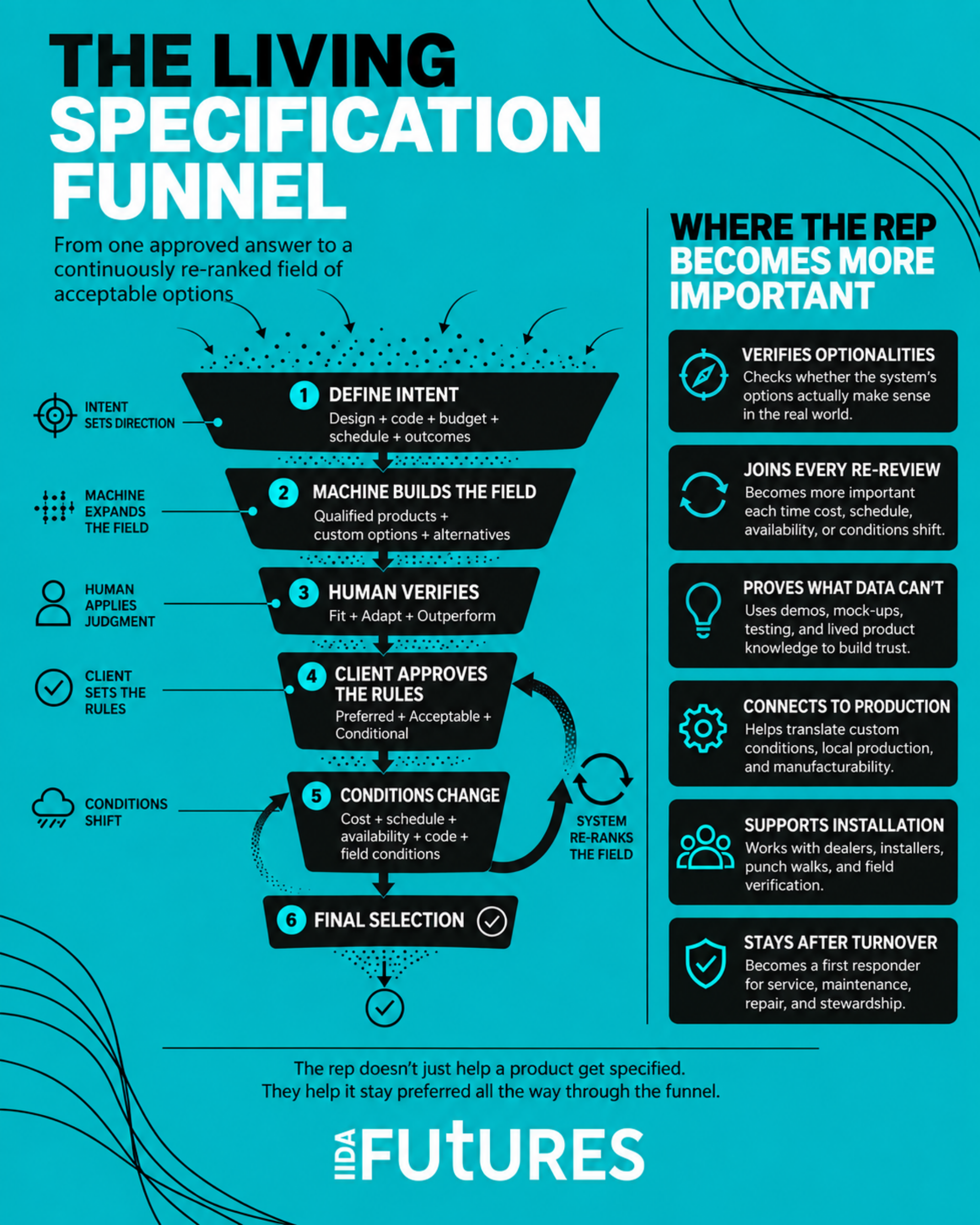
What you should see clearly is that reps already do pieces of this today, and that’s kind of the point of foresight. The future usually doesn’t arrive as a completely new job. It changes the weight, timing, and responsibility of work that already exists.
Here are the four areas where the rep’s role could expand beyond what they do today:
- Verification. Reps already provide literature, testing, certifications, and product information. In the future, they may become more of the human proof layer that verifies whether the system’s recommendation actually makes sense in the real world.
- Preference. Reps already help protect a product through calls, submittals, RFIs, and alternate reviews. If the specification funnel gets reopened more often, they may have to keep proving why the product should remain preferred each time the options are re-ranked.
- Consequence interpretation. This may be one of the newer parts of the role. A system can compare products against individual criteria, but the rep may be the one helping the team understand what happens when several project conditions overlap, and what that means for the product over time.
- Continuity. Reps already help with production, installation, troubleshooting, and post-sale issues, but those relationships could become much more active. The rep may stay closer to production and installers, and then remain connected after turnover to help verify performance, coordinate service, and make sure the product keeps doing what everyone said it would do.
All of this shows us that the future, and the changes to the specification funnel, don’t make the human rep less important. They could actually make the rep important at a lot more points along the way.