
- by Mark Bryan
- Product Design, Industry Insights, Business of Design, Future of Design
The Future of Specifications for the Built Environment
-
- by Mark Bryan
- Published in Product Design, Industry Insights, Business of Design, Future of Design
For manufacturers in the built environment, getting a product onto a project has always been a very long, very winding, and very tough road, and, for most of my career, getting to the end of that road depended on a mix of things. The product had to be right for the design, the performance and cost had to work, and very often there was a relationship behind it. A trusted rep usually introduced the product, helped us understand where it worked, brought samples, answered questions, and stayed involved long enough for us to feel comfortable putting it into the project. Then the specification formalized that decision, but even then the work wasn’t over because once the project moved into pricing, the contractor might propose an alternate, the owner might question the premium, and the designer would have to decide whether a substitution really delivered what the original product was selected to do.
What’s changing now is that automation and AI are beginning to influence that entire road, and we can already see what that looks like. Deltek’s Specpoint has more than 50,000 product listings inside the same environment where architects and engineers are researching and writing specifications, and it offers AI-assisted search, one-click specification, technical documentation, sustainability attributes, and other product information directly at the point of selection. That alone changes how a manufacturer gets considered because good data may increasingly be what gets your product into the field of possibilities. If your information is structured, up to date, and easy to verify, you’re easier to find. If it’s buried across three PDFs, an old webpage, and something only your technical department knows, you’re much harder to surface. However, searchable specifications aren’t the part I find most interesting; automation is.
Autodesk now has a patent for a generative AI construction specification interface that lets someone ask natural-language questions across specifications and project information and get summarized answers tied back to the source. The patent specifically describes an “Ask your Spec Anything” workflow, and the application published in 2025 was granted in April 2026. There’s also a patent application published in 2026 that starts to look much more like speaking the specification into existence. The system can take natural-language descriptions of what the project should be, along with things like budget, materials, environmental targets, code requirements, geometry, and even reference images, and translate those inputs into building design specifications and designs that satisfy them. You could describe something as basic as “a two-bedroom apartment with an open floor plan and a large patio,” while also telling the system what to prioritize around cost, sustainability, or code, and it begins turning that intent into something the project can actually use. That one caught my attention because I’d written about a version of this future two years ago in a speech for IIDA's Industry Roundtable. The data was pointing toward this exact moment. My scenario was more along the lines of being in a client meeting and having the client speak the parameters to life, but this is along the same lines.
To be clear, I don’t think what this all means is that we are handing the specification over to a machine and waiting for it to do all the work sans human. I think it may do almost the opposite and require more human work. In my opinion, the future specification may create more optionality, not less.
Today, we often work toward a fairly defined selection. The design team chooses the product, the client approves it, we specify it, and then we try to protect it. If what we are truly working toward is a spec system that can understand the design intent, code requirements, budget, schedule, maintenance expectations, sustainability goals, and performance criteria, it may then also be able to identify many solutions that technically satisfy the project instead of forcing the team toward one answer too soon, which means that the specification road is no longer a linear process. It means that the future of specifications becomes a specification funnel.
Here's what the funnel would look like:
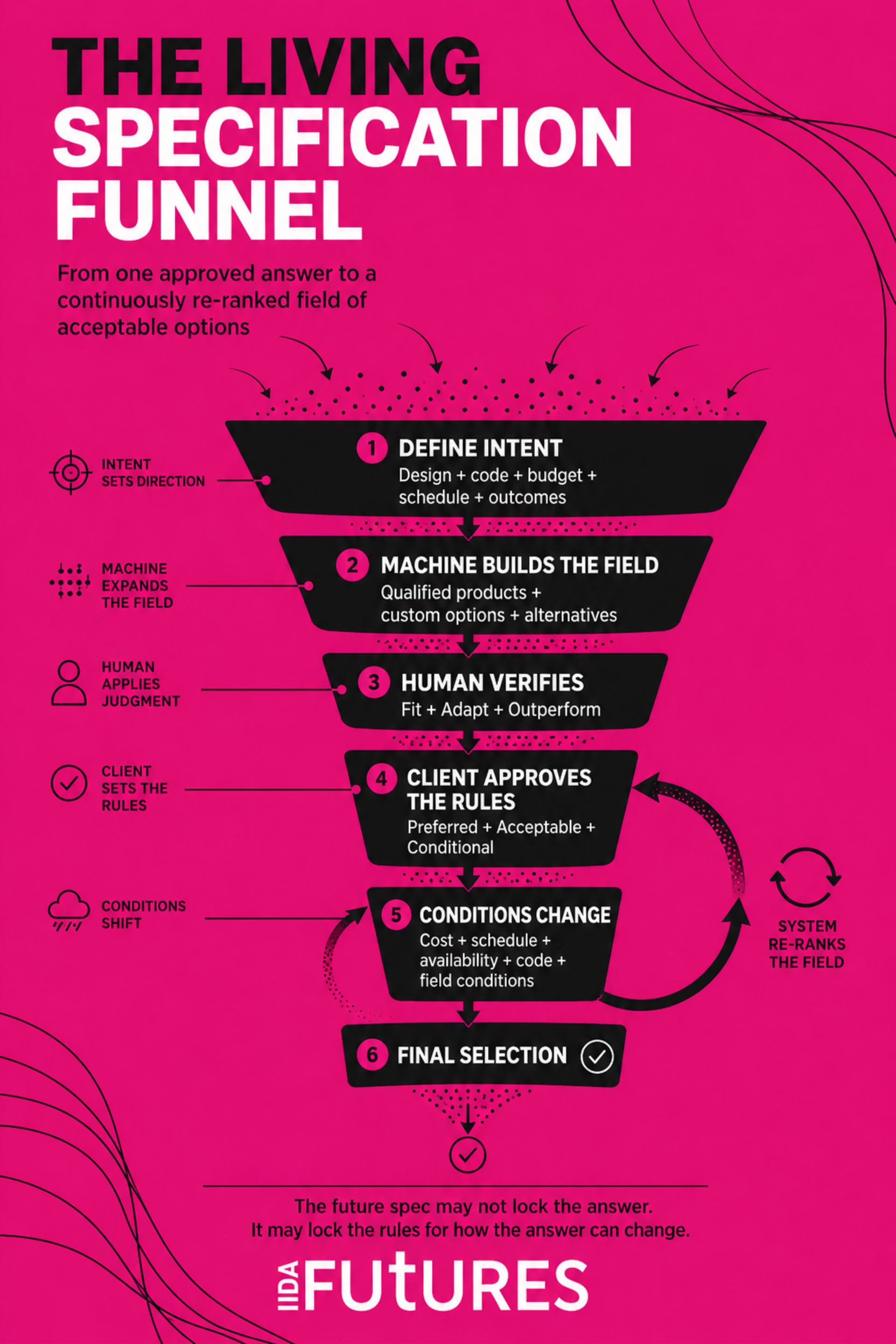
At the top, design strategy defines what the project actually needs. What can’t change? What experience are we trying to create? What has to perform a certain way? What does the owner care about over time? Which cost and schedule boundaries are real? That part may become more important because the machine can only generate useful options if we’ve clearly defined what matters.
Then automation can build the qualified field. Maybe twenty products satisfy the core design, code, cost, and schedule requirements. Some are standard answers, some can be customized, some cost more up front but offer better durability or lower maintenance, and some meet the same intent in a way the design team hadn’t thought to search for. That means the products in this field may increasingly be compared on what they can actually prove rather than what they say they do, and then the human starts narrowing the funnel.
That’s an important distinction because I don’t see a credible future where the human specifier or designer doesn’t have final authority over what gets specified. There’s too much design judgment, liability, code responsibility, client preference, and real-world nuance involved. What's truly changing is what the human is reviewing. Instead of assembling the entire universe of products manually, the specifier may be reviewing a set of pre-qualified possibilities and deciding which ones deserve to keep moving, which is kind of what they do now. This just means the automation provides a set of optionalities versus the designer selecting one product at a time.
That’s also where the workflow starts to change, because clients are used to approving the thing itself one item at a time, or even the full set of the palette. This means that the optionality sets get approved or, clients may have to approve the decision framework as well as the preferred product options. Maybe they approve one preferred selection, several acceptable options, and the conditions under which the project can move between them. If the lead time exceeds a certain point, another option becomes viable. If pricing crosses an agreed threshold, certain alternates can be considered. If a customizable product solves a field condition without changing the design intent, it can move forward, and if another product demonstrates a materially better lifecycle outcome, the team may agree to review it. And that’s where the future specification really starts to become something different, because instead of locking one answer in place, it could define the acceptable field of answers, the priorities that rank them, and the conditions under which one becomes preferable to another.
That also changes what it means for a manufacturer to get spec’d. Good structured data may get you into the funnel because the system can find and verify you, and meeting the baseline requirements may keep you there, but if you look exactly like ten other products once the system has compared everything, you’re still competing inside that field. Manufacturers will probably have to think much more carefully about what actually differentiates the product once compliance becomes easier to automate. That could be customization, a capability that isn’t widely available, better documented outcomes, lower maintenance, greater adaptability, or something genuinely new that gives the specifier a reason to move that option deeper into the funnel.
And as manufacturers learn how these systems find and compare products, we’ll almost certainly see them start optimizing their information for the tools themselves. We may eventually get a version of specification SEO, where manufacturers learn which data fields, evidence, certifications, and attributes make them more visible to the system. That could improve the quality of product information, but it also creates a new problem because a product with excellent data isn’t automatically an excellent product. The specifier may eventually have to understand not only what the system recommended, but why those particular choices surfaced in the first place.
For manufacturers, that means getting found may increasingly be a data problem, while getting through the funnel is something else entirely. And that’s where next week’s conversation about the future of A&D sales really starts, so stay tuned for my next blog on the future of A&D sales.