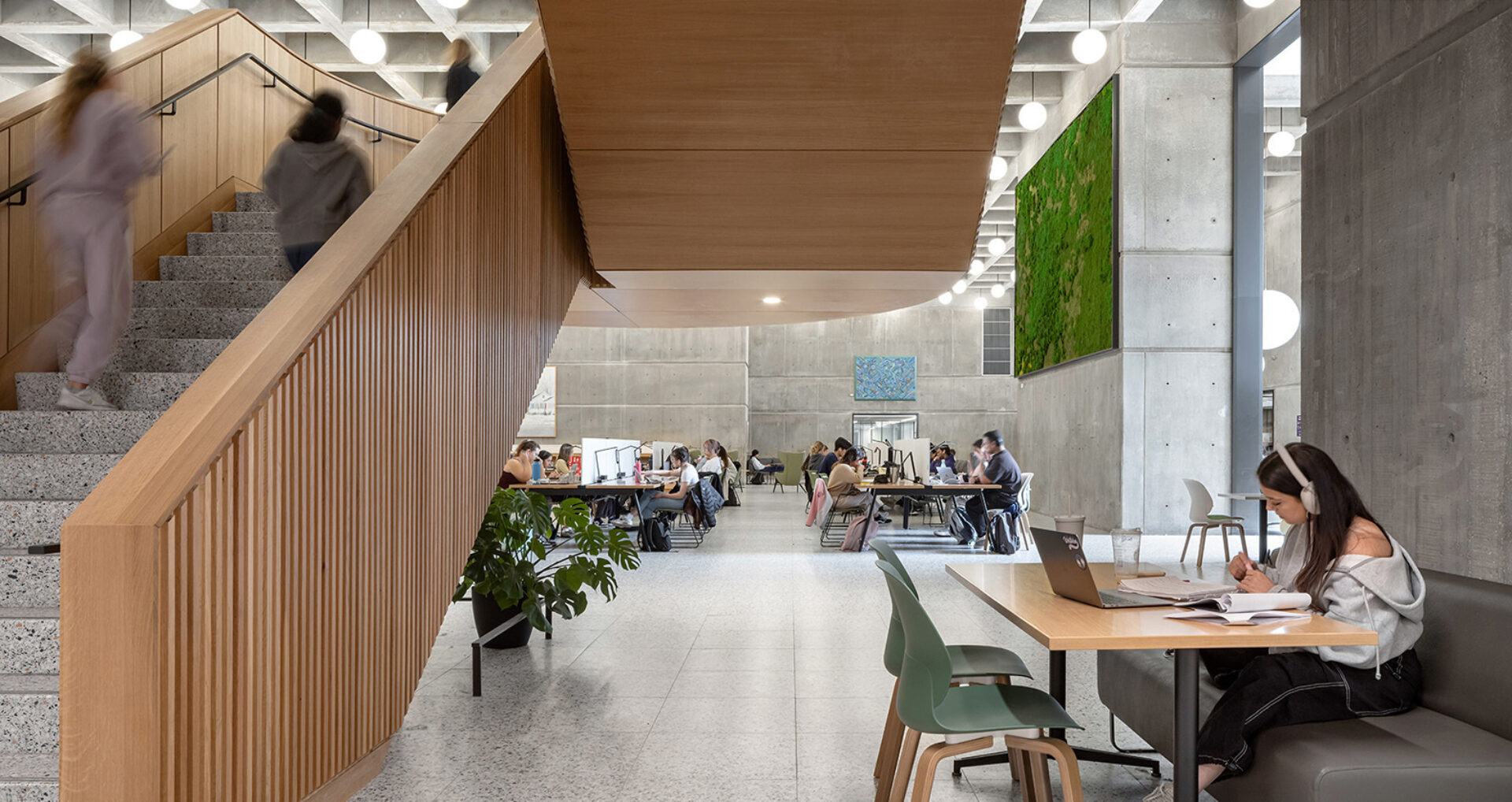
(Above image: In 2023, the Weldon Library Revitalization in London, Canada, completed by Perkins&Will, won a Global Excellence Award. Photo credit: Scott Norsworthy)
This article was originally published in the July/August issue of i+s.
The classroom is no longer one thing. On any given day, it may need to function as a presentation space, collaboration hub, feedback room, or quiet place to regroup — sometimes all at once. Students are not just absorbing information; they are documenting, revising, presenting, questioning and, well, learning how to learn in real time. Educators, meanwhile, are responding to needs that may shift from one class period to the next.
That makes educational design one of the most complex challenges in the built environment. The future will not be defined by one ideal classroom model, but by spaces that can flex with the realities of learning. Below are three shifts shaping the future of education. For designers, manufacturers, and others who work in the built environment, the opportunity is clear: create environments that make learning more visible, responsive, and human.
1. The classroom is becoming more of a feedback loop.
For decades, feedback often arrived after the fact: a marked-up paper, a final critique, a test score or grade posted days later. One shift identified in IIDA’s Future Readiness Index, a new industry benchmark and diagnostic tool to evaluate the built environment’s ability to perform under future conditions, is that learning is moving toward constant feedback instead of delayed evaluation. Teaching may shift from delivering content and grading after the fact to coaching, documenting progress, and stepping in sooner to help students succeed. One example: the University of New South Wales is replacing rank-based grading with “hurdle tasks” that test competency and progression rather than numeric scores. Meanwhile, emerging AI tools may soon be able to track student attention or confusion in real time, helping educators intervene earlier.
In spatial terms, that changes the assignment. Feedback-first environments may move away from large lecture halls and toward spaces designed for closer exchange with professors — think feedback booths or iteration studios.
For designers, the details will matter: tunable acoustics that allow for one-on-one coaching, higher-quality audio and video integration, writable surfaces, interactive flexible displays, the incorporation of wearables that provide haptic feedback, secure storage for works-in-progress and furniture that can move from individual focus to group critique.
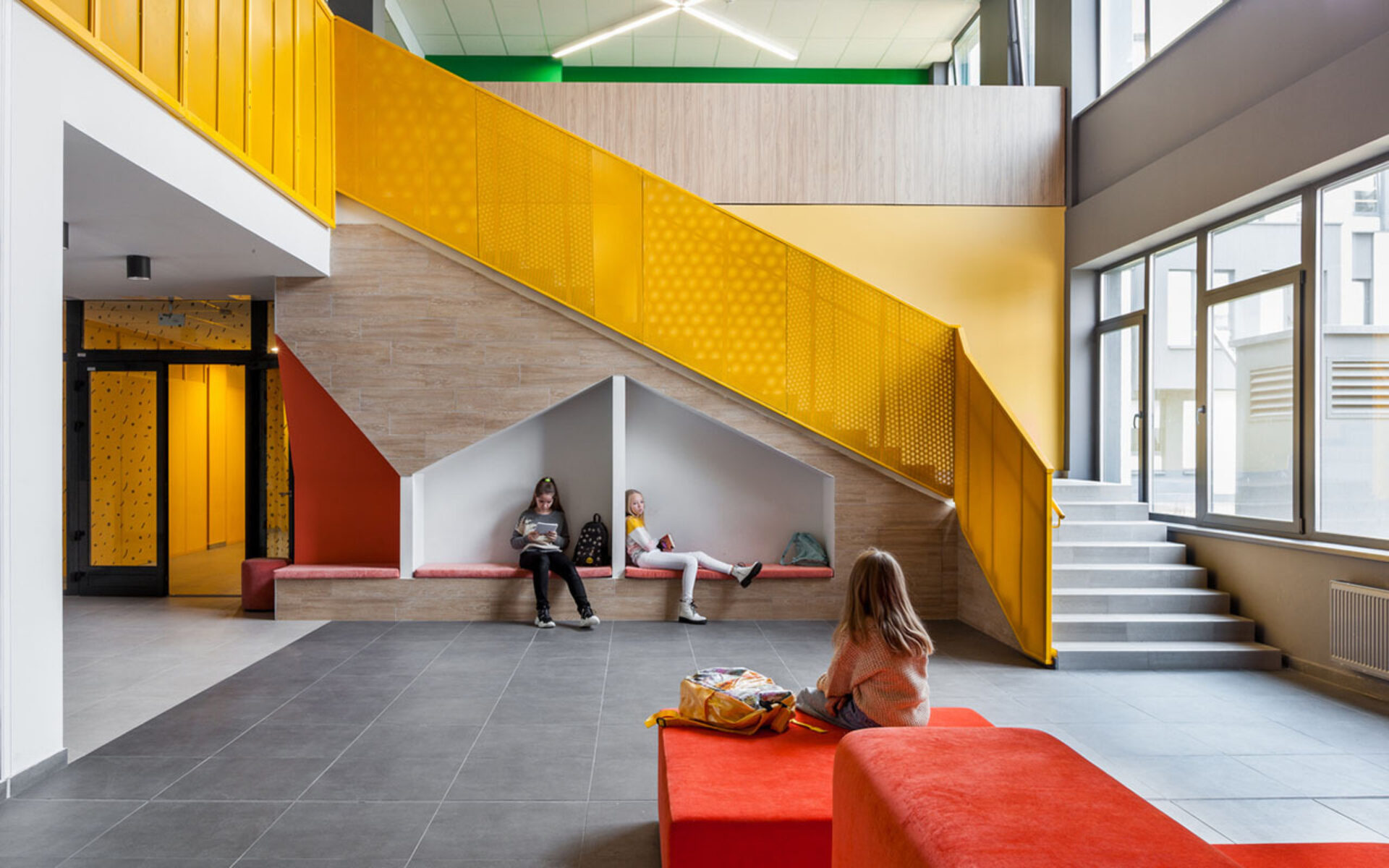
The New Borovaya School in Kopishche, Belarus, designed by ZROBIM architects, was a 2025 IIDA Global Excellence Award winner.
Sergey Pilipovich
2. Learning spaces need places to exhale.
Education is often designed around engagement, energy, and interaction — and rightly so. But students and educators are entering these spaces already overloaded, moving between screens, notifications, deadlines, and constant information. That pressure is already showing up. The Future Readiness Index points to rising demand for cognitive relief environments: spaces that help people feel calmer, clearer, and less overloaded. A recent national survey of college students found that 72% of students feel at least occasionally overwhelmed by digital life, and 34% often feel digitally exhausted — suggesting that many are cognitively taxed before they even enter the classroom.
Cognitive relief is about protecting attention. It goes beyond basic quiet rules to include truly shielded focus rooms (acoustically and visually), strictly enforced “no-notification” zones, and floor layouts explicitly designed to reduce drive-by disruptions. It also means recognizing that active learning needs recovery nearby: a low-stimulation study nook, a visually calm pocket off a busy corridor, or a quieter corner where a student can reset before returning to class. Colleges across the country are already implementing such spaces — Georgia State University created a sensory room inside a busy library, and New York University, Penn State, and the University of York have introduced low-sensory study or retreat spaces that help students regulate and recover focus. These interventions are becoming a real spatial offering, rather than a vague wellness aspiration.
Designers can create relief through better acoustic control, softer and adjustable lighting, visual simplicity, seating that supports privacy, and other furnishings that create refuge without disconnecting users from the larger learning community. They can also help change culture, encouraging educational institutions to think more deeply and take more steps to protect attention and provide cognitive relief for students, teachers, staff, and even local communities.
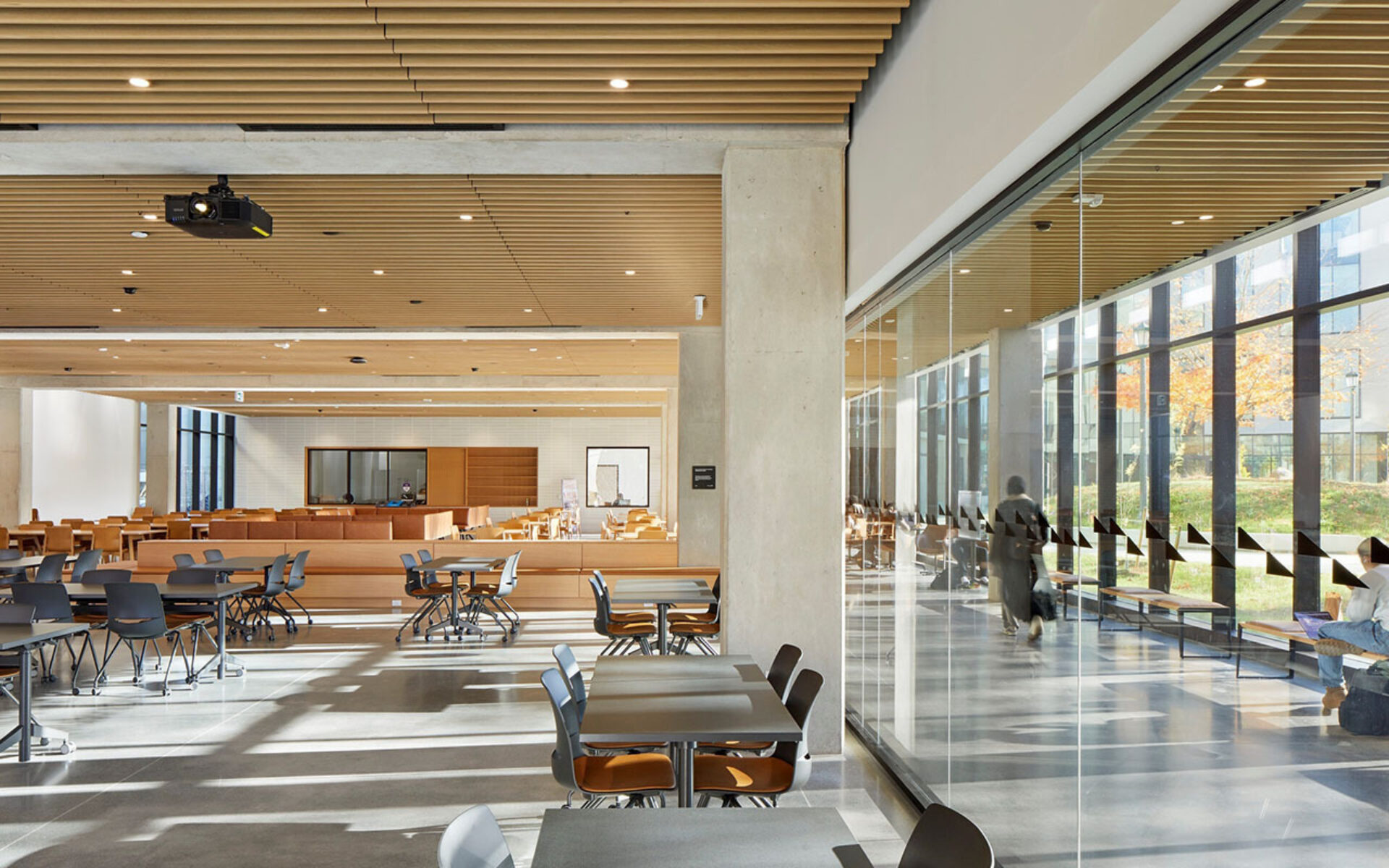
The Ronald D. Schmeichel Building for Entrepreneurship and Innovation in London, Canada, designed by Perkins&Will and Cornerstone Architecture, was a finalist in the 2025 IIDA Global Excellence Awards.
Lisa Logan Photography and Tom Arban Photography
3. Flexible has to feel effortless.
As higher education faces pressure to prove its value, the classroom has to work harder, too. Deloitte’s 2026 higher education trend report notes that employers need graduates with both immediate skills and “the agility to adapt” as work continues to evolve, especially under the influence of AI. That makes active learning — participation, critical thinking, group problem-solving — more than a teaching preference. It becomes part of how students practice the human skills they will need beyond school.
Future-ready classrooms need to be built around capability, not just content delivery. They should help students compare, question, collaborate, adapt, communicate, prototype, and work with emerging tools in real time. These are the capabilities students will need in the workforce, and the world. That means the classroom should become a platform for practicing judgment and problem-solving, with enough flexibility and infrastructure to evolve as teaching, work, and AI continue to change.
About flexibility — anyone who has taught or facilitated in a “flexible” room knows the catch: if the space is hard to change, it often does not change. A room might begin with a short presentation, shift into small-group work, open into a full-class discussion, and end with individual reflection. That sequence should not require dragging furniture or hunting for outlets.
That means specifying furniture that is lightweight but durable, layouts that do not depend on a single front of room, technology that’s accessible from multiple positions, and circulation that allows instructors and students to move easily. Storage matters, too; so do power, displays, and the ability to support hands-on materials as well as digital tools.
Related Articles
-

Visionary Futures with Kimball International
Adaptive and resilient design are the centerpiece of this annual award -

On Luck, Failure, and Listening Well
Three pieces of advice from design leaders and experts -
The Two-Speed Workplace Is Here
The gulf between those who regularly use AI and those who don’t is widening fast. For designers, that gap is about to become a design brief. -

It’s Here: The Futures Readiness Index
We explain what the Index is, how it works, and how you can harness it to meet your specific needs and goals -

A Futurist’s Origin Story
How Mark Bryan, IIDA’s chief research and strategy officer, found his way to the future -
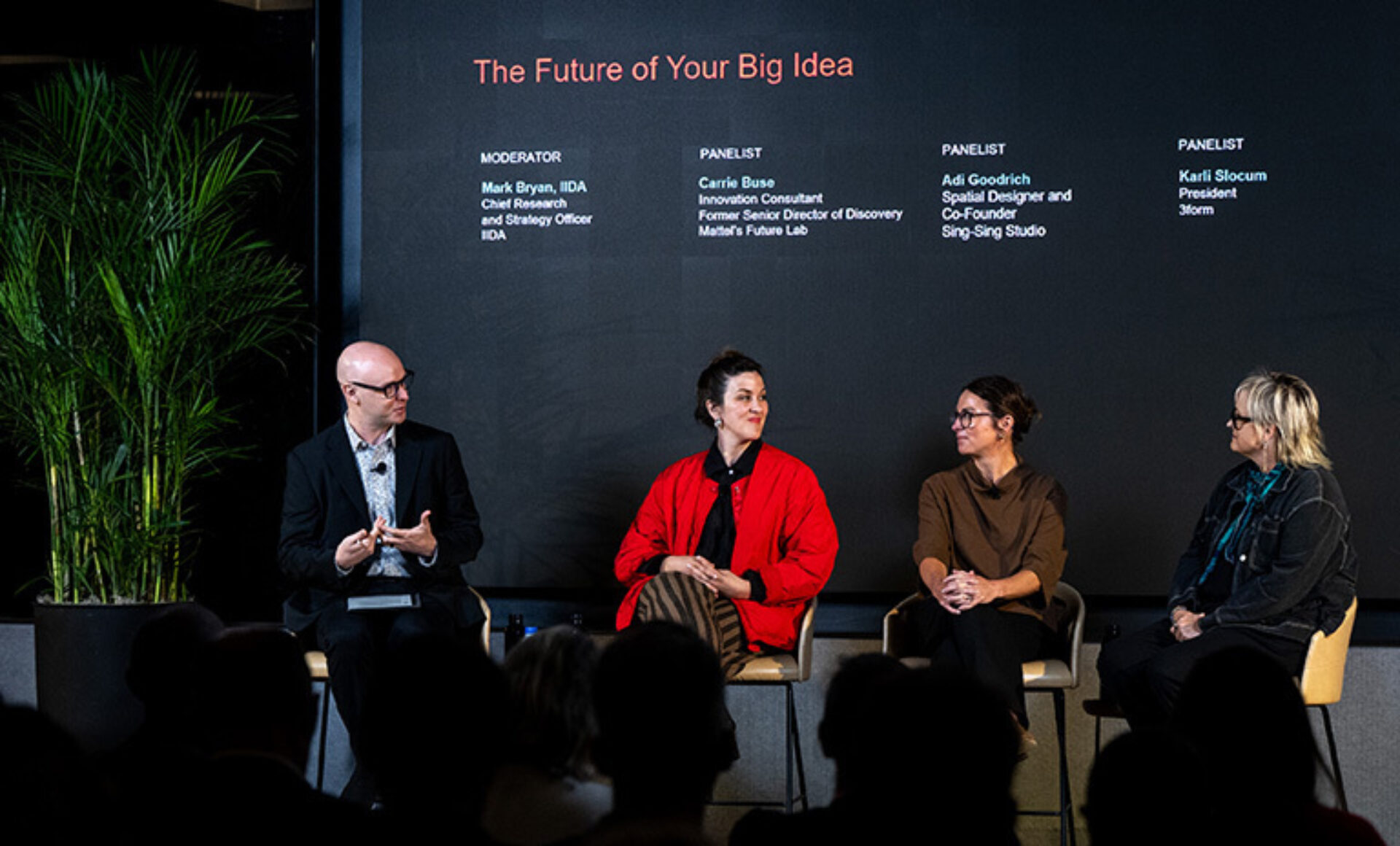
The Future of Your Big Idea
Inside IIDA’s Collective Design LIVE during Chicago Design Week