
(Above: Serenbe, a wellness and sustainably focused EarthCraft community outside Atlanta during 2025's IIDA + Interface Converge Action Summit. Photo by IIDA)
Storytelling is a powerful tool, and when it comes to sustainable design, it’s often a necessary one. Designers need to overcome the biases that clients or even colleagues hold that sustainable design is more expensive with less durability and fewer aesthetic options — that it can actually be the best choice to make. Sustainable design is an investment in the longevity of a project, an ancillary marketing tool, and most importantly, has a net-positive impact on people and the planet. For young designers, depending on where they work, that can also mean getting buy-in from their firm leadership which can feel intimidating — leaving some to wonder, where do you even start?
In 2025, IIDA’s Converge Sustainability Council asked this question: “What are some concrete ways we can integrate sustainable choices into our work?” The Council is made up of designers who meet quarterly, and is made up of past attendees of the Converge Action Summit, an annual event hosted by Interface and IIDA. The summit brings together sustainability leaders and emerging designers to share knowledge and strategies to increase sustainable practice in their communities.
Council mentors Stacey Crumbaker, IIDA, Assoc. AIA, an associate principal at Mahlum; Paul Shahriari, founder and innovation officer at Ecomedes; and Joey Shea, former manager of North American sustainability at Interface provided guidance on developing a mindset of sustainability and telling the story that defends it.
Over the course of last year, the Council discussed sustainable practices that work, ways to get started, and tools that can make sustainable design more intuitive. Below are seven takeaways to embrace sustainable design at any point in your career.
Prove that sustainability is a sound investment — and a marketing tool
Many clients do want healthier choices, but stepping away from something tried and true (like materials they’re already familiar with) can feel like an expensive gamble. When you can provide clear, credible data to prove that sustainability isn’t always more expensive, or even a risky move, it becomes an easier sell. Gather studies, find information on healthy materials, research regenerative buildings and circular design, and find comparable sustainable projects to show your clients. Guide them to see sustainability as a better choice and safe investment. And remember, there is often a bigger value in how the sustainability story is told than in the data itself. Call people in, not out. One member shared that at her firm, the marketing team has been an integral partner, making the case to firm leadership by presenting sustainable design not only as a sound investment, but also as an invaluable marketing tool. When you reach out to others at your firm, you might be surprised just how much buy-in there is!

Photo by IIDA
Don’t ask permission, but set sustainability as your baseline
Crumbaker says it’s important to remember that as a designer, some of the most impactful parts of your work are things end users can’t see. Designers are paid to use their expertise, and Council mentors agree that you should feel empowered to make greener choices whenever and wherever you can, at any stage in your career. “Demand it from yourself,” says Shea. “After all, your client is paying you to make thousands of decisions that they don’t even know exist.” By choosing sustainability as your baseline — making your product and material decisions from options that meet your sustainability benchmarks — it just becomes one of the constraints you design within. Shea also argues that advocating for sustainability in your work is easy; you don’t have to wait around for someone to ask for it. Focus your storytelling on the final product, pointing out to your client, for instance, that “not only did we give you great design, we gave you the added bonus of being LEED-certified,” which in turn becomes a powerful marketing tool for the client.
Data can be your friend — embrace tools that make it easy
When Shahriari founded Ecomedes, he wanted to simplify specification — making complex data easier to digest. The tool (which is free for IIDA members) not only gathers product data across rating systems like LEED, WELL, Mindful Materials, and others, but it generates documentation, provides you with marketing points to your client, and ultimately saves you time (and money) on research. His favorite tips are: One, keep everything organized and sorted by project so you can easily access your separate portfolios and download documentation for each; and two, leverage the data to tell a story after a project’s complete — it’s easy to illustrate how much money you saved, and share any other other achievements or certifications that the project has earned. Oftentimes your client doesn’t realize that they can do both — be economical and sustainable. When you integrate sustainable choices in your work, everyone wins.
Develop a sustainability framework, and put your materials library to work
Another great tool to take advantage of is your materials library. During one Converge Council meeting, Stacey Crumbaker and guest speaker Claudia Saunders took us behind the scenes at their firm, Mahlum, to share how they optimized their material library to reach their sustainability goals. The first step is to develop a framework of criteria for your firm's material library — Saunders recommends leveraging the science and research that already exists by familiarizing yourself with systems like the AIA Materials Pledge or Gensler Product Sustainability (GPS) Standards. Mahlum also developed a color-coded ratings system to make material assessment and selection easier — you don’t have to dig too deep into the data to know what each item meets. They’ve developed scripts and questionnaires for communicating material guidelines to reps, ensuring consistent messaging and understanding — if a product doesn’t meet the benchmarks, it’s not in the library. It’s important to maintain regular education for staff and reps so that everyone understands their individual roles and goals. Saunders notes that hosting regular lunch-and-learns is a great way to brush up on product and rating education as a team. When your materials library only gives you sustainable options, you’re always going to choose a sustainable product. It allows you to focus more on selling the aesthetics and performance of a material or product that you feel good about because it already meets your preferred criteria.
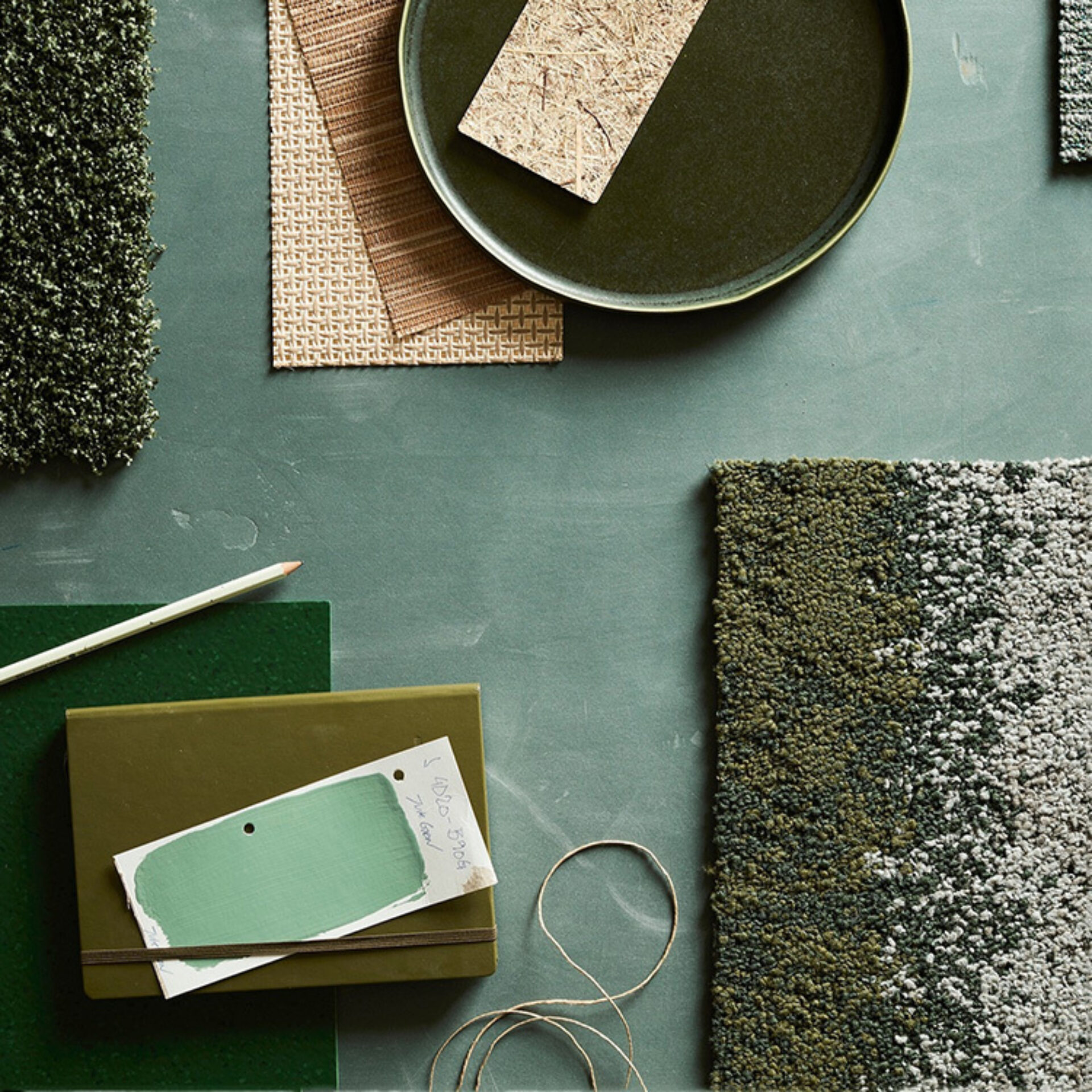
Image courtesy of Interface
Stay optimistic — progress comes in many shapes and sizes
When looking at getting rid of harmful materials, are the alternatives always better? Take vinyl for instance. While many firms are moving away from the material because of its detrimental effects on human health, and its dangerous implications at nearly every touchpoint of its lifespan — it’s important to measure the implications of the replacement. Shea asks, “Are we really making a healthier choice if we’re replacing one unhealthy material with another, like petrochemicals?” Saunders says that if we know something is dangerous, we have to at least try to do better and explore new options — and that doesn’t mean we will find the best replacement immediately. We may not always find a perfect solution, but we’re making changes and seeking improvement, and that is ultimately better than accepting the status quo. Crumbaker says that questions like these are why it’s important to consider things like product longevity and lifecycle when considering material health — don’t forget to consider the Environmental Product Declarations (EPDs), and the impact of overseas production and deconstruction as we think about material health. Getting it right (or more right than wrong) sometimes means accepting small wins.
Find a balanced approach when it comes to your use of AI
Recognizing that there’s a big push from big tech right now to use AI, Council member Paridhi Chawla, IIDA, is worried that there are “no guardrails around the actual environmental impacts from the use of AI.” The possibilities of incorporating AI into our workflow are endless and exciting — for instance, it can make the boring, repetitive parts of our jobs more efficient. But the energy burdens and implications of AI use can be overwhelming to consider. On a micro-level, Shea recommends looking for voices talking about it with a balanced viewpoint. And eventually lend your own voice towards pushing towards throughful and responsible use of these tools; it's key that we all slow down to consider our impact. If you’re worried about the wastefulness of AI, Shahriari reminds us that there are many tools out there that don’t use it. Use a database or tool like Ecomedes or your material library that already has the data stored for you rather than Chat GPT. Crumbaker notes that we are in the middle of massive societal and cultural change, and that can be scary, but it’s important to take a long and holistic view, because AI is not going away. “Once the genie is out of the bottle, it won’t go back in. So, how do we hold space to talk about it with each other?”
Bottom line: Be the change you want to see
If you see an obstacle or problem that makes you think, “somebody has to do something about this — be that person!” says Reem Makkawi, IIDA, founder and executive director of FurnitureMatch and a guest speaker at a Converge Council meeting. As a New York-based designer, she was regularly confronted with the problem of waste — people’s individual waste on garbage day and industry waste during deconstruction. She would also hear tales of overflowing warehouses of used office furniture sitting in New Jersey, yet firms repeatedly invest in new furniture for every project. Makkawai recognized that we have a huge waste problem — and not just in our industry. She developed a vision to reframe surplus or discarded furniture as a resource, not trash, and called it FurnitureMatch. Working with her IIDA chapter (New York), she designed the platform for circular design and recruited other like-minded designers and industry members to join the cause. Connecting donors like showrooms, firms, the New York Department of Sanitation, and installers, to places in need, like local nonprofits and schools. She says that the first step is to find collaborators who are willing to buy into your idea and help you to build momentum towards tangible change. While FurnitureMatch is still in its early stages, she sees great potential and hopes that other IIDA chapters and communities follow the course. “Sustainability is a culture of coordination,” she says, “It’s not just a department, but a collaboration.”

Image courtesy of FurnitureMatch
Related Articles
-
The Future Is Reclaimed and Reused
The systems thinker, materials storyteller, and architect who sees reuse not as nostalgia, but as a path to equity and climate resilience -
Real Talk About Reuse and Sustainability
Three questions the design industry should ask itself, based on takeaways from the Interface and IIDA Converge Action Summit -

Behind Seattle’s Groundbreaking Climate Pledge Arena
Blending preservation with state-of-the-art innovation helped to achieve the world’s first net-zero-carbon arena -

Seeding a More Sustainable Future
The Keilhauer Sustainable Design Education Fund reimburses IIDA members who commit to green design -

5 Strategies for a More Sustainable Future
Our top 5 takeaways from the Converge Summit, Interface and IIDA’s annual gathering of designers and sustainability leaders -
Funding a Greener Future
The Keilhauer Sustainable Design Education Fund reimburses IIDA members for their commitment to sustainable design