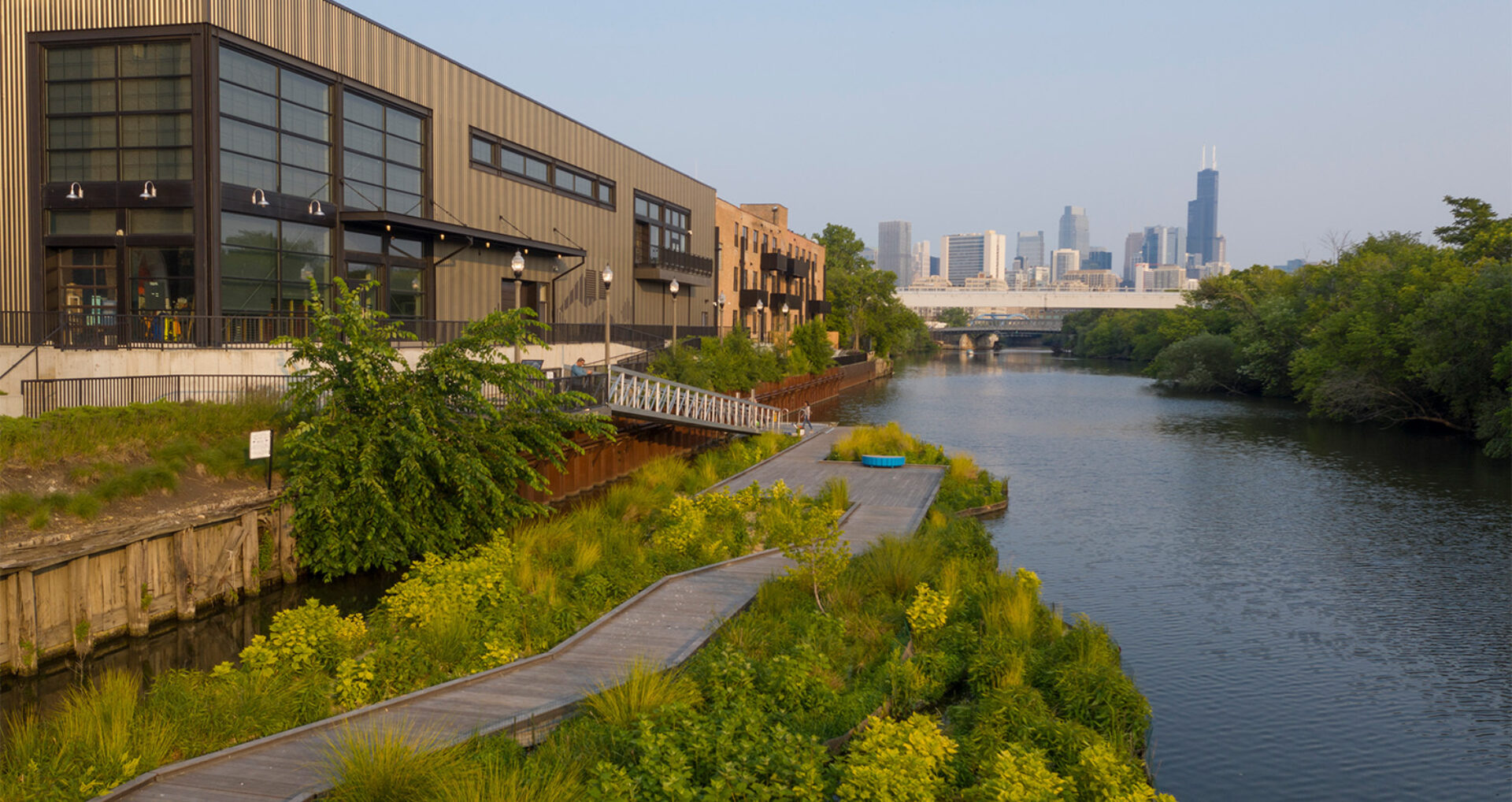

(Above: Wild Mile floating eco-park in the Chicago, a first of it's kind. Photo by Scott Shigley)
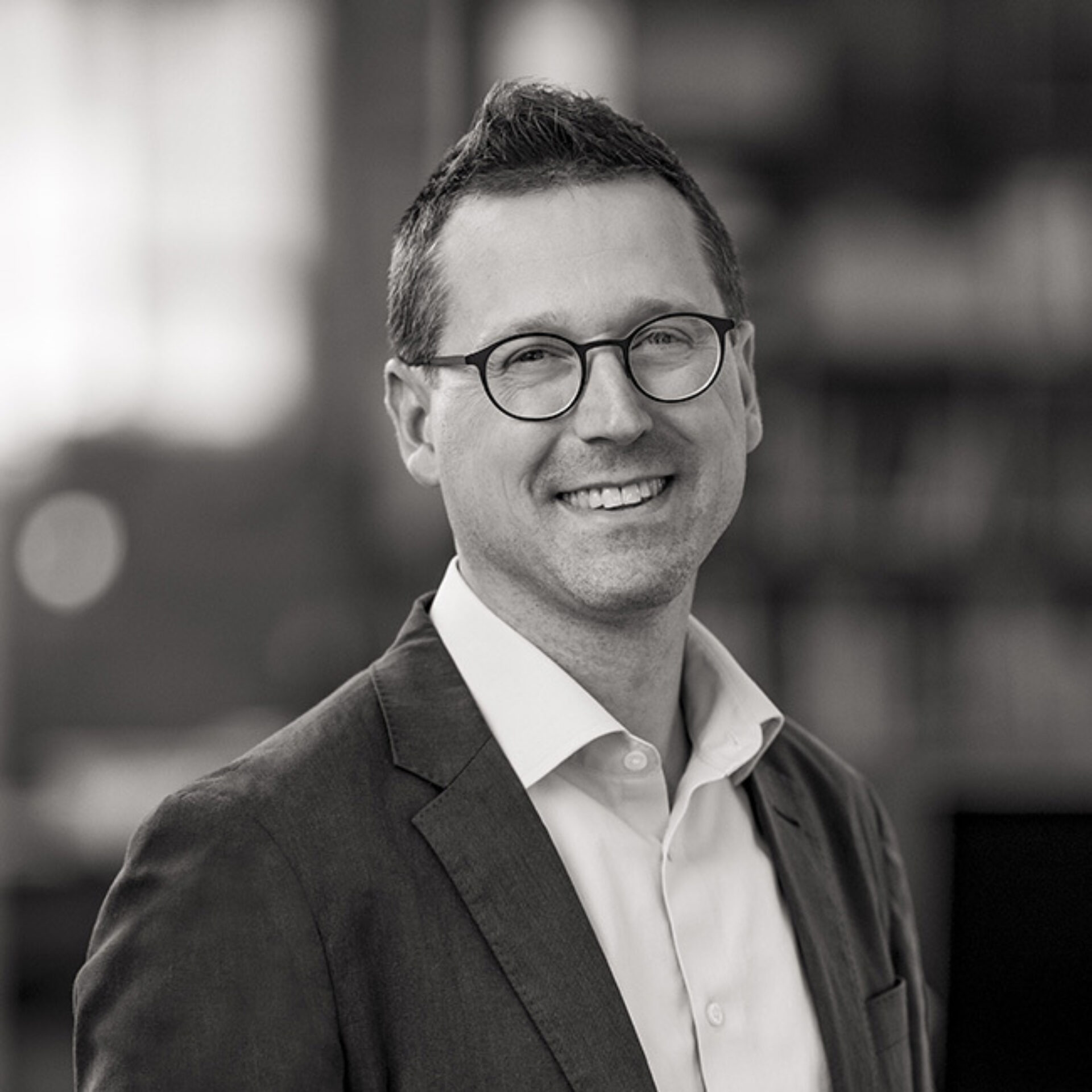
Michael Skowlund believes deeply in democratizing nature — that everyone deserves access to outdoor spaces and landscapes. For the Chicago-based landscape designer, that could mean a perfectly balanced backyard that gracefully changes with the seasons or a public park. Either way, he’s fond of any opportunity to take an underutilized urban area, fill it with native plants and provide a place for human connection — a space for people to reconnect with the natural world, the city around them, and each other.
Skowlund, who grew up in Wisconsin, spent his childhood outdoors — canoeing, exploring rivers, camping, Boy Scouts, you name it — and his early career in the Pacific Northwest and on the East Coast. He later returned to the Midwest and set down roots in Chicago, a city that’s not only world-famous for its architecture but also its extensive parks system. At Hoerr Schaudt, a firm he credits for being “where I really fell in love with landscape architecture,” Skowlund leads a team as principal and design director and harnesses the unique power of horticulture, a skill set he learned in part from his mentor Peter Schaudt.
“Landscape architecture blends technical and creative thinking, which I really love,” he said. “And you can make a huge impact — improving people’s daily lives and even helping the health of the planet.” Take the Oklahoma City corporate campus that he worked on, helping shape outdoor space across a 3.5-acre site for oil and natural gas company SandRidge Energy. Oklahoma City is one of the windiest cities in the country, according to Redfin; to combat this, Skowlund worked with a team to study local wind patterns and potential solutions. They built urban “shelter belts” to block the seasonal winds, creating bands of trees that serve as windbreakers; built out overhead solar protection; and leaned into crafting welcoming places for employees and the public to gather outside and enjoy greenspace. Once completed, the project gave people the chance to comfortably stay outdoors longer in spring and summer — and more time spent outside in beautiful natural spaces allows for healthier populations.
According to the American Psychological Association, exposure to nature and the outdoors has positive impacts on mood and cognition. Making it not just ideal, but essential to prioritize stewardship of natural landscapes and parkland in urban areas, especially since most Americans spend nearly 90% of their time indoors. “There’s a visceral connection — humans have an underlying psychological longing for being in nature,” explains Skowlund. “It’s a safe statement to make that people really need nature. I get to deliver that in such a meaningful way.”
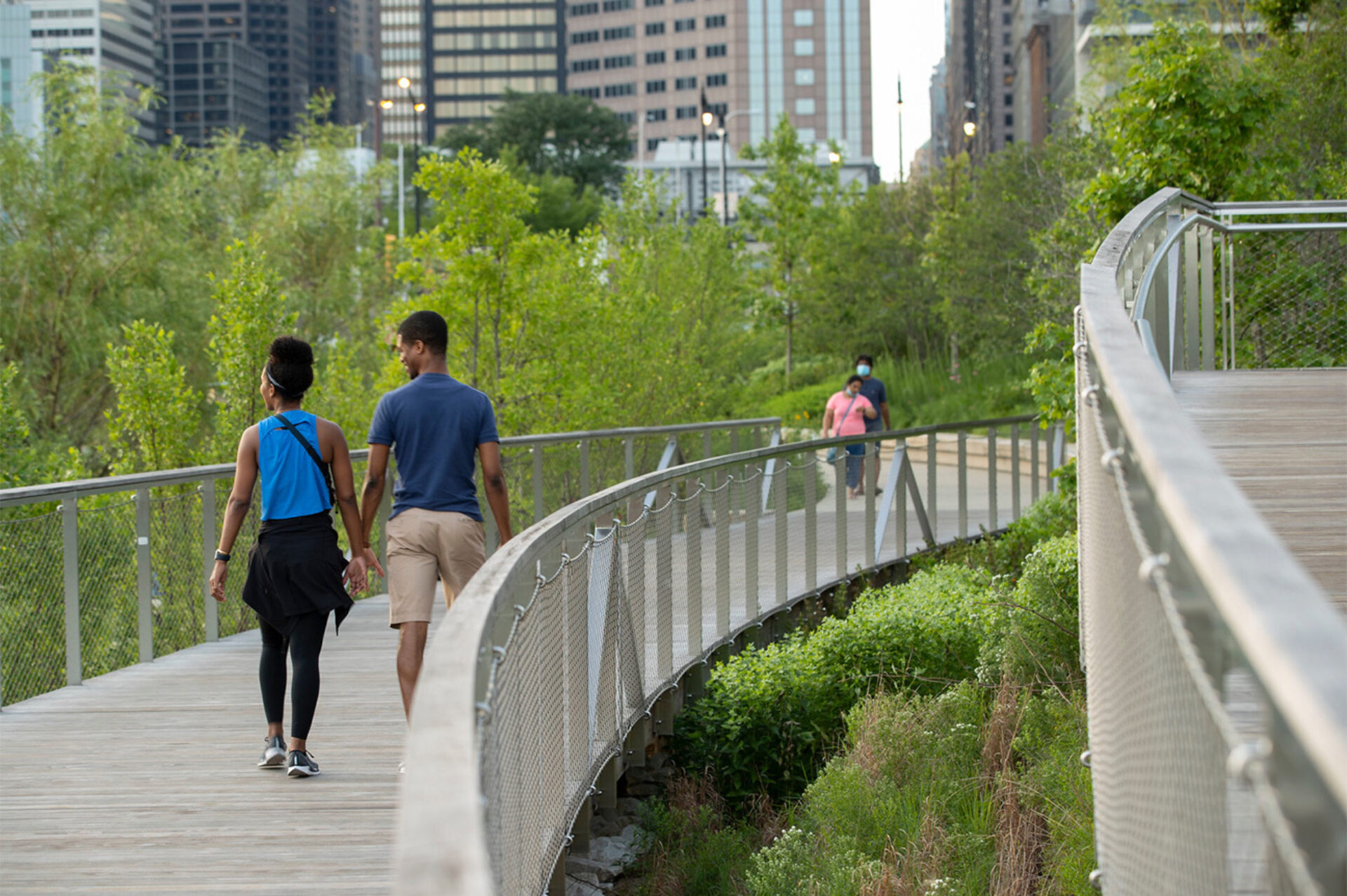
Photo by Scott Shigley
Landscape design reconnects cities to neglected areas
While Hoerr Schaudt designs gardens across contexts, from high-end private residences to academic campuses, Skowlund is particularly drawn to developing public spaces like parks along the Chicago River, which he’s quick to mention is “where my heart is.” For a city built on wetlands and marshes, the fingerprint of the industrial revolution is still omnipresent, especially along the riverfront. The river — famously reversed by 1900 in an incredible feat of engineering — served as a hub for shipping and barges. In 1857, Ogden’s Canal (named after Chicago’s first mayor, William Ogden), also called the North Branch Canal, was dug east of the area now known as Goose Island to allow ships and barges to bypass a curve in the river and navigate further inland. Today, the river is no longer an industrial hub, but the infrastructure remains, including a large seawall that’s still a main feature of the river in downtown Chicago and the surrounding areas. This wall leaves the river and the land disconnected, preventing wildlife — and people — from having an easy path in and out of the water.
And until recently, the mile-long North Branch Canal was mostly forgotten, with few access points and fewer attractions. Enter Urban Rivers, a nonprofit organization that was commissioned by the city in 2018 to return the one-mile channel and surrounding area into not just a more natural space, but a hub for community, which is part of their ethos. “A beautiful river lined with lush greenery and public walkways brings life to the community and connects local communities to nature,” Urban Rivers says on their website. Their flagship project is the award-winning Wild Mile, the world’s first floating eco-park that “takes a wildlife-first approach to public greenspace.” The landscape architect for that project? Micheal Skowlund.
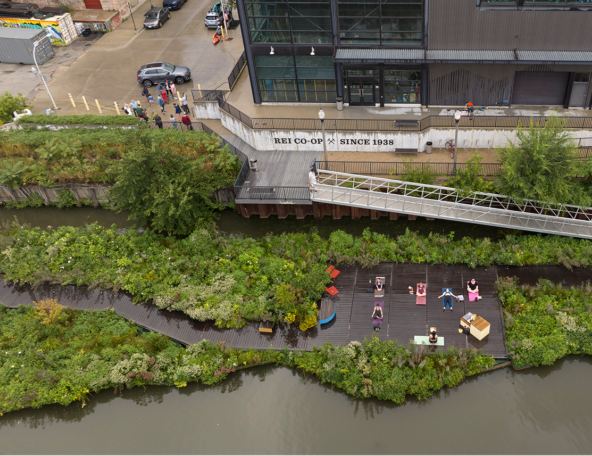
Photo by Scott Shigley
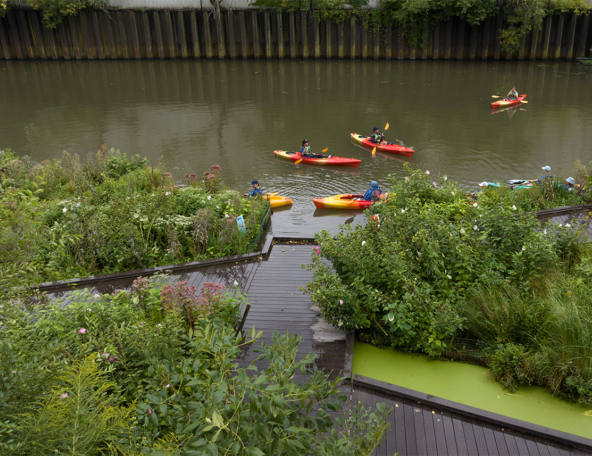
Photo by Scott Shigley
“To be honest,” he says, “I think that’s my favorite job I’ve ever done. I learned a lot from that job.” At the time he was working with Omni Ecosystems, where he developed his guiding vision of democratizing nature. For the Wild Mile, Skowlund served as the lead landscape architect working in tandem with Urban Rivers, Skidmore, Owings, and Merrill (SOM), community groups, and the city to establish the Wild Mile Framework Plan.
The ongoing project consists of (currently) 700 linear feet of floating modules alongside the river, not only acting as a community gathering space but also improving the ecological health of the river. “We turned an industrial river into a more welcoming river,” Skowlund says, not only for “human recreation, but by returning a shoreline to the plants and animals.” The floating park is a public space for anyone to access and enjoy — from environmental scientists conducting research to kayakers and outdoor yoga events — reconnecting people to the water’s edge and serving as an adaptable space for wildlife that are native to the river. The Wild Mile is accessible at street-level via an entrance point that takes you to the water-level park — and it’s even ADA-accessible.
“It’s providing beavers and otters a place to get from water to land, something they couldn’t do with seawall,” he notes. But it goes beyond the beavers. There’s a broader ecological impact.
The floating modules that make up the Wild Mile gardens allow for plant roots to grow directly into the river. “It all starts with the soil,” Skowlund explains. “The microbes in the soil support the plants, which act like a water filter.” And that’s an important step in cleaning up the river. Wetland plants capture pollutants including heavy metals. The root system also provides shelter and food for fish, turtles, and even endangered freshwater mussels that filter water every day. “The ecological web that inhabits these modules improves the river habitat and cleans the river in really remarkable ways,” he adds, “and all of this is very common in many urban rivers. It’s a repeatable intervention,” meaning that while this is the first floating eco-park, it ideally won’t be the last.
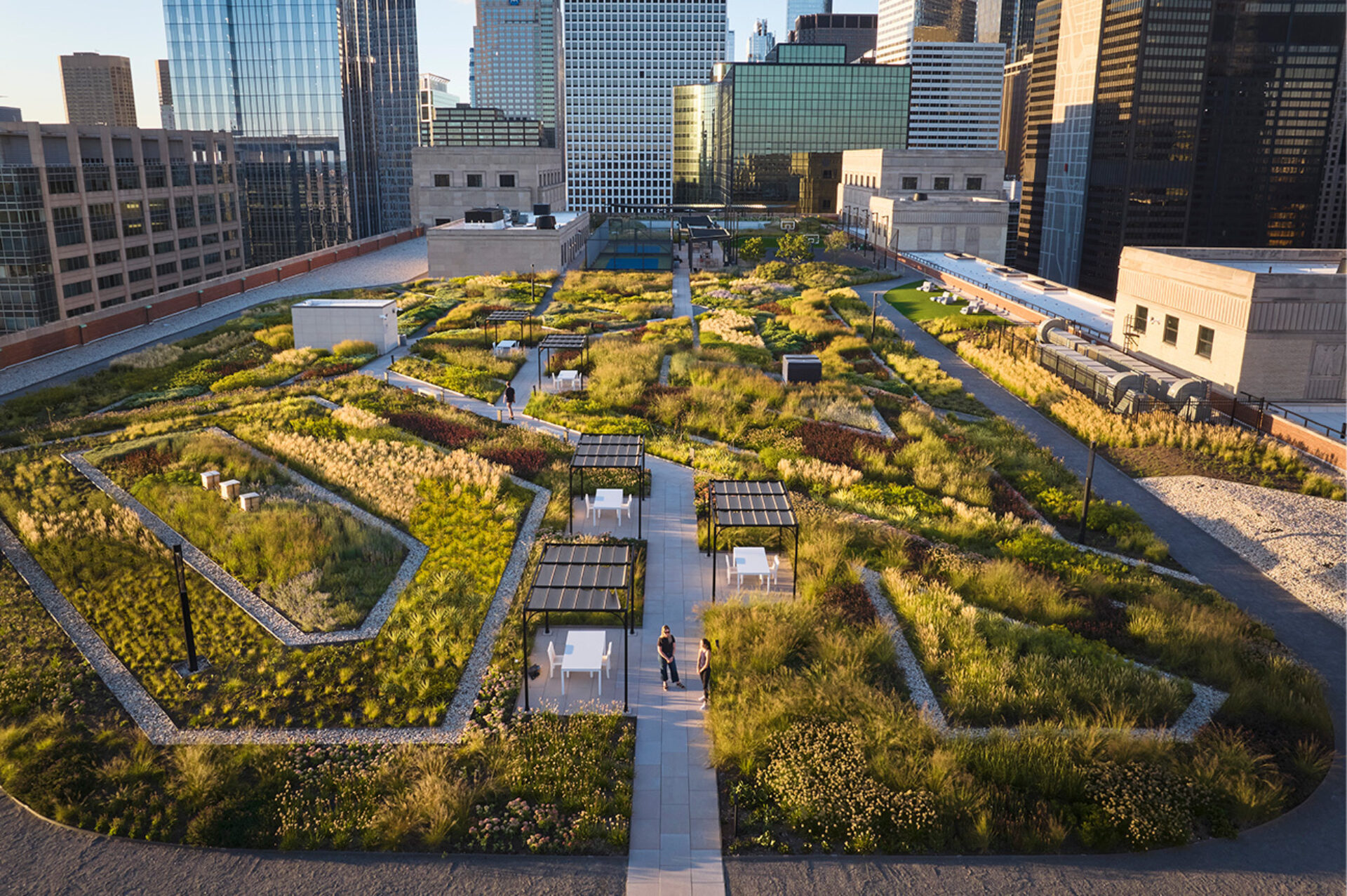
Photo by Dave Burk
Designing for future impact
Landscape projects aren’t something that you design, complete, and close the book on. Designers must consider the natural evolution of the plants themselves. In the case of the Wild Mile, Skowlund and his collaborators accounted for the fact that the space will evolve as the project expands and new (animal) residents move in. “Stewardship is a big piece of designing a landscape — you don’t just build it and walk away.” Skowlund says. “You have to be really mindful of how to future-proof the projects.” That includes thinking about who will be taking care of the garden, and especially in Chicago, given the change of seasons. “Are these plants going to be easily recognizable to a maintenance person, versus a weed? Are they going to be hardy enough to withstand the changing climate? What sorts of irrigation do we need?” These are the sorts of questions he asks across landscape projects.
“The horticulturists and plant designers I work with are so dialed into what works in different zones and what plants work together in a plant community,” he explains. And then there’s the aesthetic aspect.
“Every plant has its own color and texture — the leaf size, shape, branching and the structure of the plant in full” all play into the visual effect. When he designs gardens, Skowlund’s not just thinking about the lushness of summer, but also the time of year when everything is dormant. “When everything is defoliated, we’ve also designed the herbaceous material — from the actual structure to the shape the stems and branches will take.”
“You’re thinking about space over a time horizon,” Skowlund says, drawing upon an oft-quoted truism: “A building will look its best on day one and then start to age, whereas a landscape will look its worst on day one and will improve as it ages and fills out.” But that doesn’t mean the building and the landscape are best designed as separate entities; rather, he believes he does his best work in tandem with a multidisciplinary team that considers all aspects of interior and exterior as one coherent vision. “It’s not about the building versus the landscape. It’s about the integration of the two … it’s one big comprehensive and cohesive design.”
For Skowlund, that’s the point. He loves the outdoors, and deeply enjoys reconnecting humans to nature. And yet, “the best part about being a landscape architect is just working with people,” he says. “The collaborative nature of problem-solving together.”
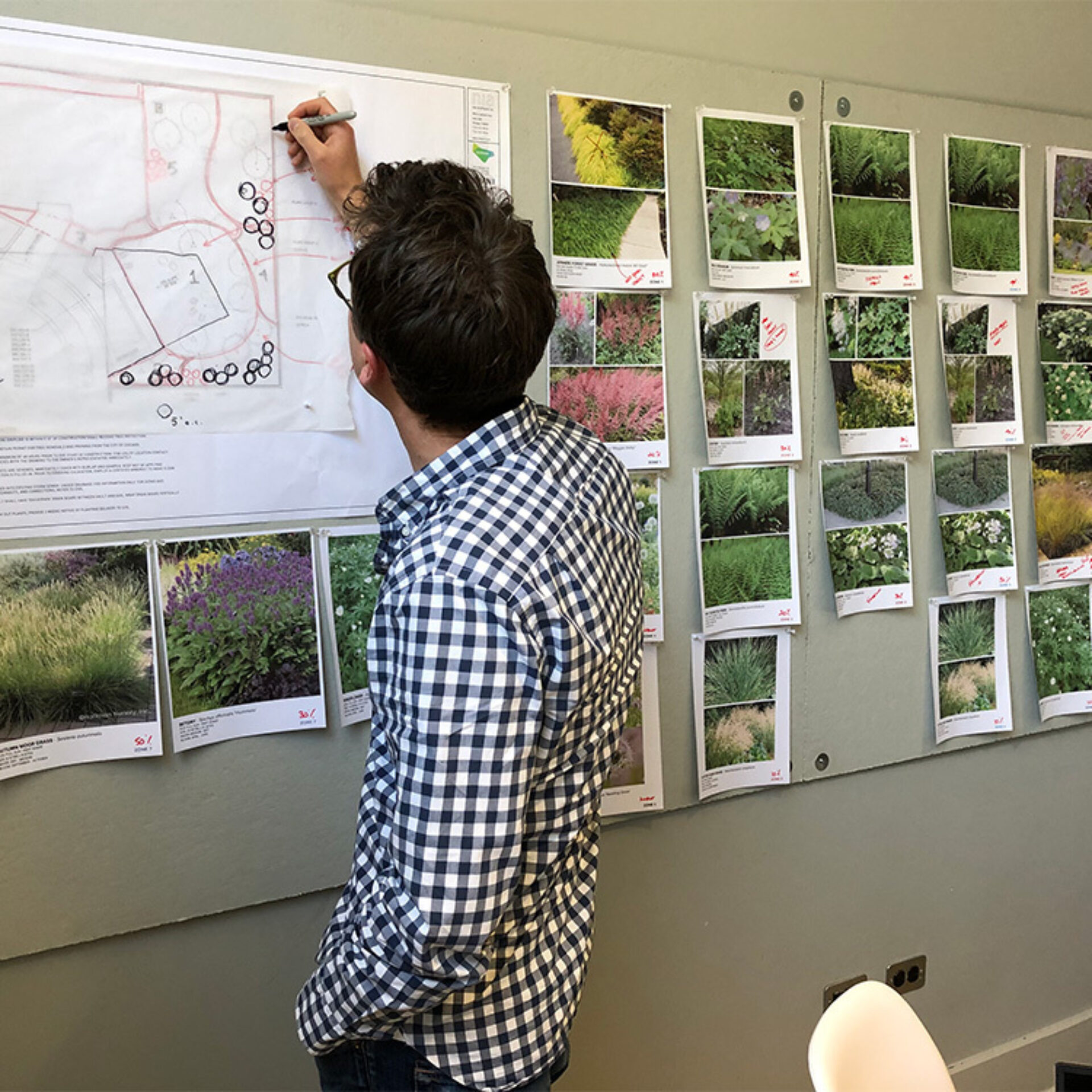
Image courtesy of Michael Skowlund
Related Articles
-
Rapid Fire with Yinka Ilori
First instinct, no overthinking: Yinka Ilori takes us inside his Dunelm collection -
Rising Stars: IIDA Members Going Beyond
Get to know designers moving the needle in advocacy, sustainability, mentorship and more -
Perspective: Design Superstars
These design superstars have set themselves apart with their dedication to doing what it takes to make the world wonderful -
We Need More Third Spaces
Three designers talk about their favorite third spaces and share design tips to foster connection -
11 Questions with Michael Skowlund
We ask our magazine cover subject 10 rapid-fire questions, plus a bonus too good to ignore -
Shaping Spaces for Connection
Two designers with a passion for holistic design discuss how to create spaces that go beyond function and foster human connection